
What if you know the answer during the NAC OSCE, but lose marks because your communication, timing, or station structure is weak?
The NAC OSCE does not only test what you know; it tests how safely, clearly, and professionally you perform under pressure.
For many International Medical Graduates (IMGs), success and strong preparation involve regular mock OSCE practice, effective communication, clinical reasoning, and a clear understanding of Canadian patient-centred care expectations.
These NAC OSCE tips for IMGs can help you build confidence, improve performance across different station types, and avoid common mistakes.
Candidates can improve their chances of success by participating in regular mock OSCE sessions over 8 to 12 weeks.
In this article, you’ll learn practical strategies for preparing for the NAC OSCE, including how to approach patients, take focused histories, manage your time, and counsel patients.
Therefore, let’s get started!
What Is the NAC OSCE?
The NAC OSCE is Canada’s clinical skills exam for International Medical Graduates.
The Medical Council of Canada calls it the National Assessment Collaboration Examination, which assesses whether IMGs are ready to enter a Canadian residency program.
Your NAC OSCE result directly affects your CaRMS eligibility. Many residency programs use it as a first-pass screening tool. A strong score expands your residency options. A weak score limits them.
IMGs who want to apply to the CaRMS R-1 Main Residency Match need to provide results for the MCCQE and the NAC Examination.
The exam tests clinical performance. IMGs must show that they can take focused histories, communicate with patients, perform or describe physical examinations, build reasonable diagnoses, and make safe management decisions in a Canadian clinical setting.
Jallah Academy supports this exact preparation need. The academy offers IMG-focused Canadian licensure preparation through online and in-person classes, one-on-one mentoring, crash courses, physical examination training, and video lectures.
NAC OSCE Format: Stations, Timing, and Standardized Participants
The NAC OSCE is a half-day Objective Structured Clinical Examination.
Candidates rotate through clinical stations that simulate common patient encounters in Canadian medical practice. The exam is usually administered twice a year, in spring and fall.
The standard NAC OSCE has 12 stations. Two stations are pilot stations and do not count toward the final score. Each station lasts 11 minutes. You get 2 minutes between stations to read the door note and prepare.
Each station starts with a written prompt. The prompt explains the clinical problem and tells the candidate what to do, such as taking a history, conducting or describing a physical examination, or managing a patient concern.
Each station includes standardized assessment roles. The candidate interacts with at least one standardized participant, while a physician examiner observes and scores the encounter.
Station types include,
- History-taking only
- Physical examination only
- Combined history, exam, and management
- Communication-focused encounters (breaking bad news, counseling, consent)
What the Exam Actually Tests
The NAC OSCE tests clinical performance. Examiners score you across six core areas.
1. Clinical Reasoning: Generate a focused differential early. Ask hypothesis-driven questions. Show logical thinking through your line of inquiry.
2. Communication Skills: Speak clearly, listen actively, and respond to the patient. Canadian clinical culture prioritizes patient-centered communication. Formal or detached language will cost you marks.
3. History Taking: Take a structured, efficient history within the time limit. Cover presenting complaint, associated symptoms, past medical history, medications, allergies, family history, and social context.
4. Physical Examination: Perform the correct exam for the clinical scenario. Examiners look for proper sequencing, hand hygiene, patient draping, and accurate technique.
5. Patient Safety and Professional Behavior: Introduce yourself. Obtain consent. Respond appropriately to distress. Every station assesses if your conduct is safe and professional.
6. Management Reasoning: Close each encounter with a coherent plan. State your top diagnosis or working impression.
NAC OSCE Tips for IMGs: Practical Strategies to Improve Your Performance
The following NAC OSCE tips for IMGs can help you prepare more strategically and perform with greater confidence on exam day.
Tip 1: Understand Canadian Clinical Expectations
Canadian clinical expectations define strong NAC OSCE performance. A general foreign OSCE approach may not match what the NAC OSCE expects.
Treat this as a different test entirely. The medical facts matter. How you apply them, with whom, and in what tone matters more.
Canada Expects a Specific Type of Doctor
Patient-centred care is the core standard of Canadian clinical practice. The Medical Council of Canada describes the communicator role as patient-centred therapeutic communication.
Shared decision-making is expected in every management discussion. Explain options clearly, check the patient’s understanding, invite questions, and include the patient’s values.
Communication Style
Open every encounter with a warm, professional introduction. State your name and role. Confirm the patient’s name.
Use plain language. Replace “elevated myocardial infarction risk” with “your heart is under serious strain.” Speak to the patient, not at them.
Empathy must match the patient’s concern. Say something specific when the patient shows fear, pain, frustration, or confusion.
For example: “That sounds very worrying, especially because the pain started suddenly.”
Safety and Consent
Consent protects professionalism and patient safety. Ask permission before asking sensitive questions, performing physical examination steps, or discussing counselling topics.
Use consent naturally, especially during sexual history, psychiatric history, family violence, substance use, or physical examination stations.
Maintain correct exam conduct throughout. Proper draping, patient positioning, and physical boundaries are observed and scored.
Professionalism
Professional behaviour matters throughout the station. Maintain respectful language, avoid jargon, listen without interrupting, protect dignity, and stay calm under pressure.
Close every encounter with a clear, respectful summary. Recap the key points. Check the patient’s understanding. Ask if they have questions.
Jallah Academy teaches Canadian-style NAC OSCE performance. Its NAC OSCE curriculum prepares IMGs to perform at a Canadian PGY-1 level through patient safety, communication, professionalism, structured clinical reasoning, and OSCE-specific performance skills.
Tip 2: Use a Clear Station Structure Every Time
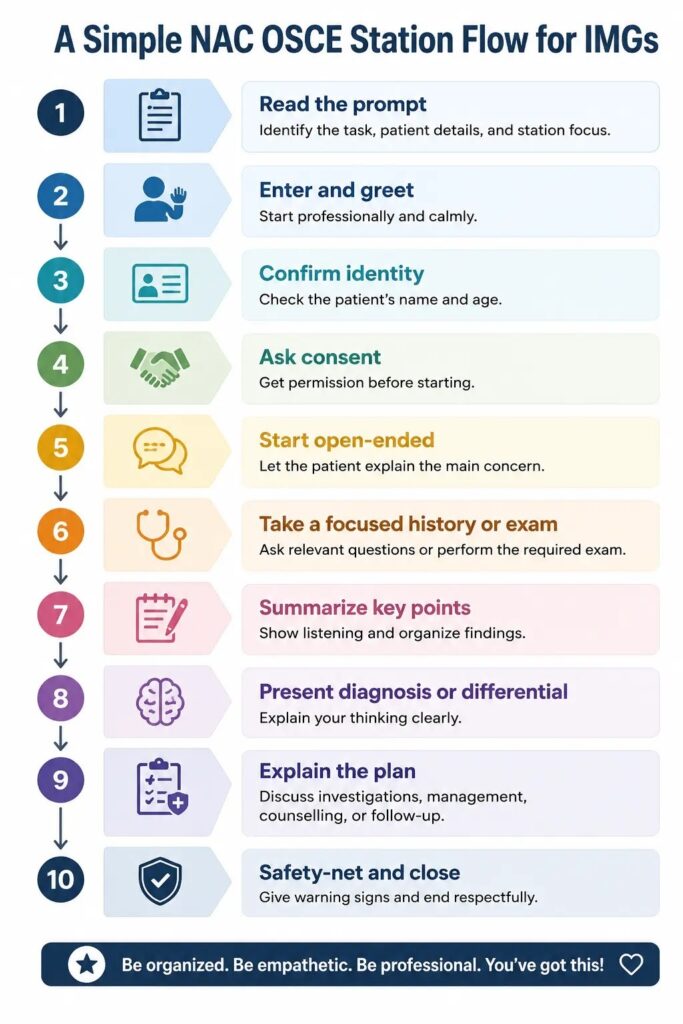
Use the same station flow every time.
Read the prompt, identify the task, greet the patient, confirm identity, ask consent, complete the focused task, summarize findings, explain the plan, safety-net, and close professionally.
Tip 3: Manage the 11-Minute Station Like a Skill
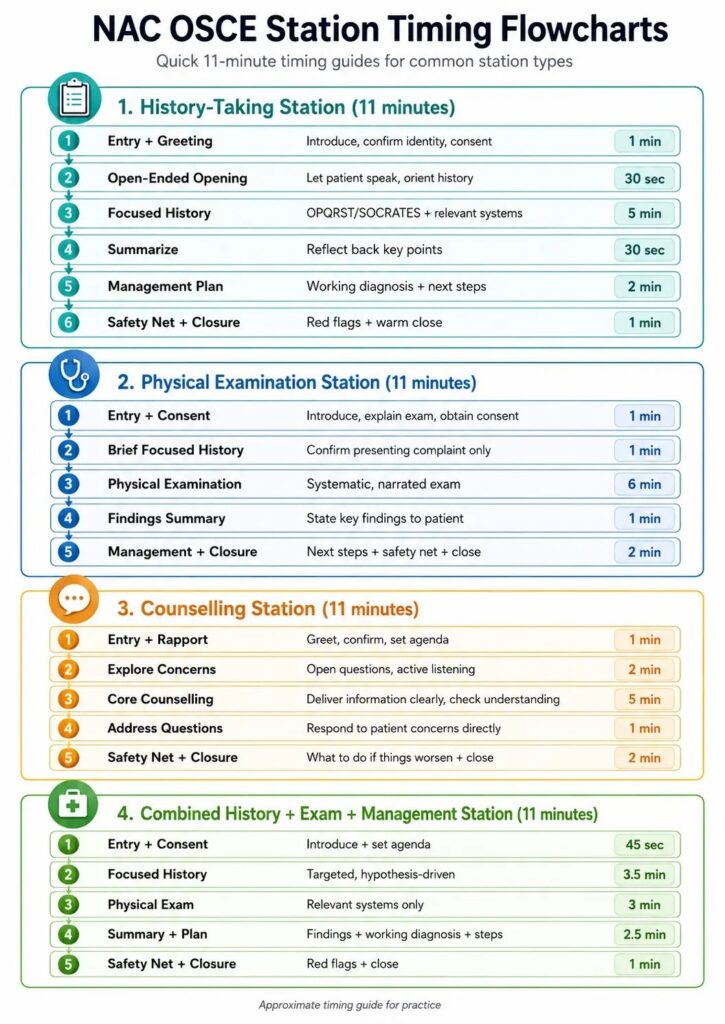
Each NAC OSCE station lasts 11 minutes, with 2 minutes between stations to move, read the instructions, and prepare for the next task.
Use the door prompt to control the station. Read the clinical task first, then identify what the examiner wants: history taking, physical examination, counselling, management, oral questions, or a mixed station.
Know exactly where you should be at the 4-minute mark, the 7-minute mark, and the 9-minute mark.
Sample Time Breakdown for History, Exam, Counselling, and Closure
Use this table as your baseline time allocation per station type. Adjust by 30 to 60 seconds based on complexity, but never abandon the structure.
Tip 4: Practice Patient-Centred Communication
IMGs often lose marks here, not from weak clinical knowledge, but from communication style. Formal, detached, or examiner-directed language signals a lack of patient focus.
Four skills determine your communication score:
Empathy: Acknowledge what the patient is feeling before moving forward. A single empathy statement changes the tone of the entire encounter. Don’t skip it when a patient shows distress, fear, or hesitation.
Active listening: Let the patient finish. Don’t interrupt within the first 30 seconds. Nod, maintain eye contact, and reflect what you hear.
Plain language: Avoid medical terms when speaking to patients. Say “heart attack,” not “myocardial infarction.” Say “fluid in the lungs,” not “pulmonary edema.”
Checking understanding: Close every explanation by confirming the patient understood. Don’t ask “Is that clear?” It puts the burden on them.
Ask, “Can you tell me back what we discussed so I can make sure I explained it well?”
Jallah Academy helps IMGs practise this exact skill set. Its NAC OSCE preparation includes communication-focused station practice, counselling support, structured feedback, and mentorship.
Tip 5: Do Not Stay Silent During Physical Examination Stations
Silence during a physical exam station costs you marks. Examiners cannot score what they cannot observe.
Verbalize everything relevant. Not commentary for its own sake, purposeful narration that signals competence. Here is what to verbalize and when:
Hand hygiene: State it before you begin. “I’m just going to clean my hands before I start.” This is a patient safety marker.
Consent and positioning: Ask before you touch or reposition. “I’d like to examine your abdomen now. Is it okay if I ask you to lie flat?” Consent is a scored behavior.
Comfort checks: Acknowledge pain or discomfort during the exam. “Let me know if anything I do causes you pain. I’ll stop immediately.”
Clinical findings: Narrate what you are eliciting as you go. “I’m palpating for the liver edge now… I can feel it approximately two centimeters below the costal margin.”
Transitions: Signal when you move between exam components. “I’ve finished the abdominal exam. I’d now like to check for shifting dullness.”
The rule is simple: if the examiner cannot hear your reasoning, they will not assume it exists. Narrate your exam like you are teaching a medical student standing beside you.
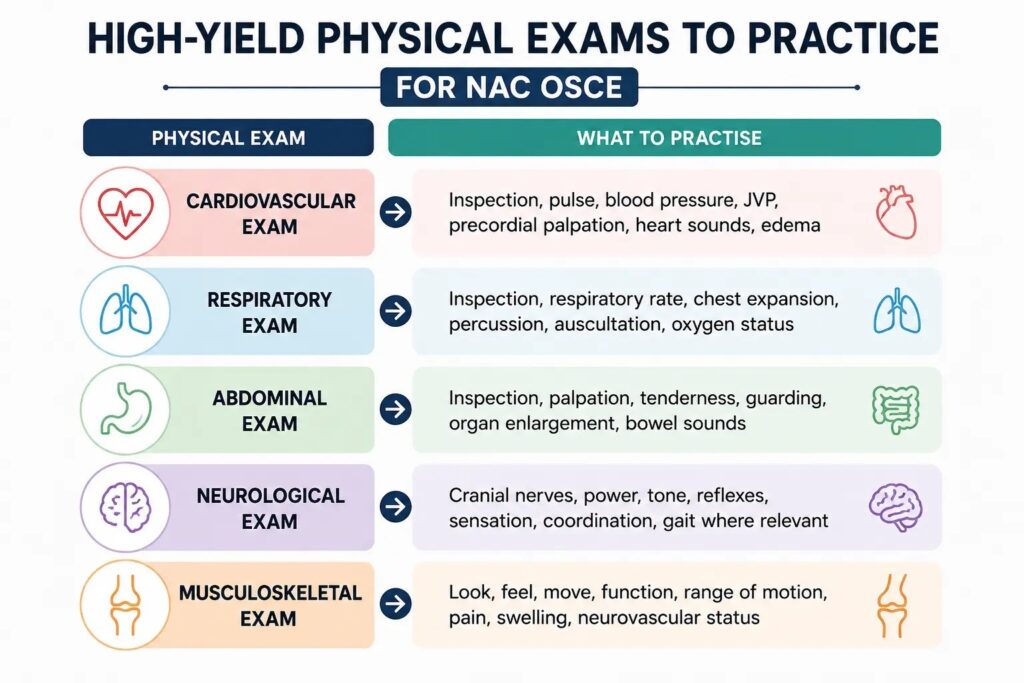
High-Yield Physical Exams to Practice for NAC OSCE
IMGs should practise the core systems that commonly appear in OSCE-style clinical encounters and connect each exam to symptoms, findings, and management.
Tip 6: Build a Focused Differential and Management Plan
Present your top three diagnoses. A focused differential diagnosis shows stronger clinical reasoning than an exhaustive list. Examiners want to see that you can prioritize.
Lead with your most likely diagnosis. Follow it with two plausible alternatives.
Use this structure every time:
“My most likely diagnosis is X. I’m also considering Y and Z. The reason I want to rule out [red flag condition] is because of [specific finding].”
Order tests that directly confirm or exclude your top diagnoses. Avoid ordering a full panel as a default. Name the test. State why you’re ordering it. Keep it brief.
Use a three-part differential structure. Say the likely diagnosis first, mention two or three reasonable differentials, then identify any dangerous condition you must rule out.
Avoid the two most common IMG mistakes here:
Over-talking the plan. A long, unfocused management discussion signals uncertainty. Say what you’d do. Say why. Stop.
Skipping the patient. Deliver your plan to the patient, not to the examiner. Use plain language. Confirm understanding.
Tip 7: Prepare for Ethics, Counselling, and Difficult Conversations
Ethics and counselling stations are high-scoring opportunities.
Know four core ethical pillars cold: informed consent, confidentiality, decision-making capacity, and mandatory reporting obligations. These concepts appear across multiple station types.
Use the SPIKES protocol for breaking bad news. Set up → Perception → Invitation → Knowledge → Empathy → Summary. Follow this sequence every time.
Capacity should be assessed when decision-making seems unclear. Check if the patient can understand information, appreciate consequences, and communicate a choice.
If a station involves domestic abuse, suicidal ideation, or child safety, address it clearly. Staying silent on safety issues is a critical fail point.
Pause after delivering difficult news. Silence signals empathy and gives patients space to process.
Tip 8: Use Mock Exams and Feedback Before the Real NAC OSCE
Mock exams are the most effective NAC OSCE preparation tool available. They simulate real exam conditions: timed stations, standardized patients, and live feedback.
Reading about station structure is preparation. Performing it under a timer in front of an observer is training.
Run timed mock stations early. Starting early gives you time to identify weak areas, correct them, and re-test before the real exam.
Tip 9: Avoid the Most Common NAC OSCE Mistakes IMGs Make
Poor time management is the top offender. Over-investing in history leaves no time for a management plan, safety net, or closure. Know your 5-minute and 8-minute checkpoints.
Weak or missing closure is a direct mark loss. Always reserve 30 seconds. Summarize, safety-net, thank the patient.
Lack of empathy is heavily penalized. Canadian examiners expect emotional responsiveness.
Unfocused physical exams signal poor clinical reasoning. Let history guide the exam.
Over-relying on foreign OSCE materials is a high-risk move. PLAB and USMLE CS formats don’t reflect Canadian clinical expectations.
Tip 10: Create a 4- to 12-Week NAC OSCE Study Plan
Your plan needs four non-negotiable components: station practice, communication drills, physical exam technique, and timed mock exams.
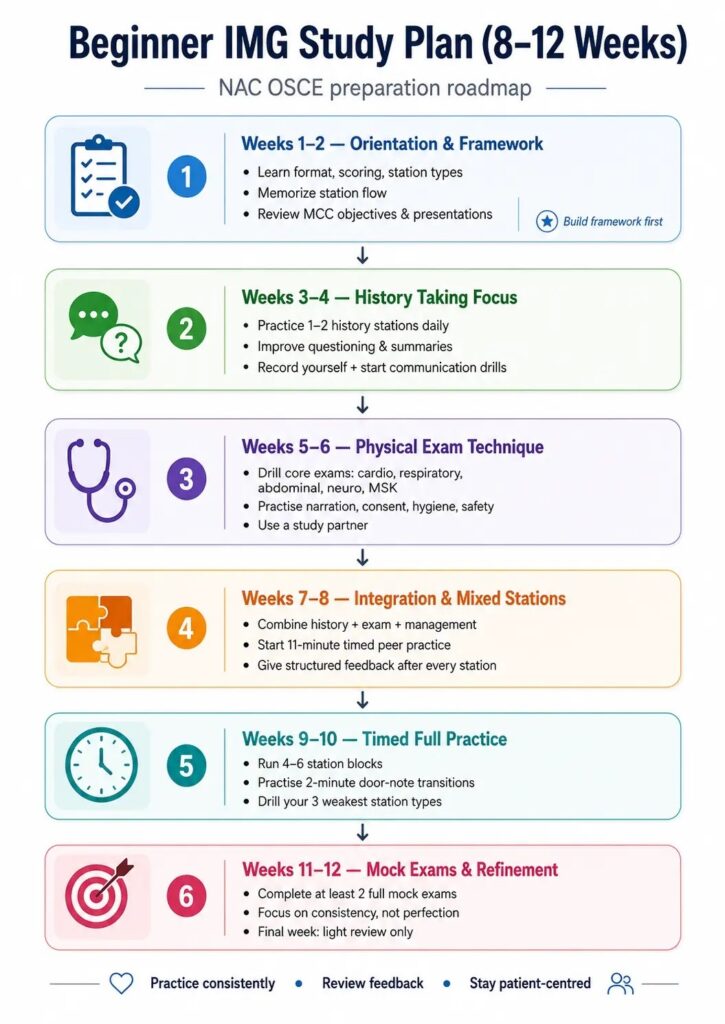
Beginner IMG Study Plan (8 – 12 Weeks)
Use 8 – 12 weeks if this is your first attempt or if you have limited prior OSCE exposure. This timeline allows you to build skills systematically before adding time pressure.
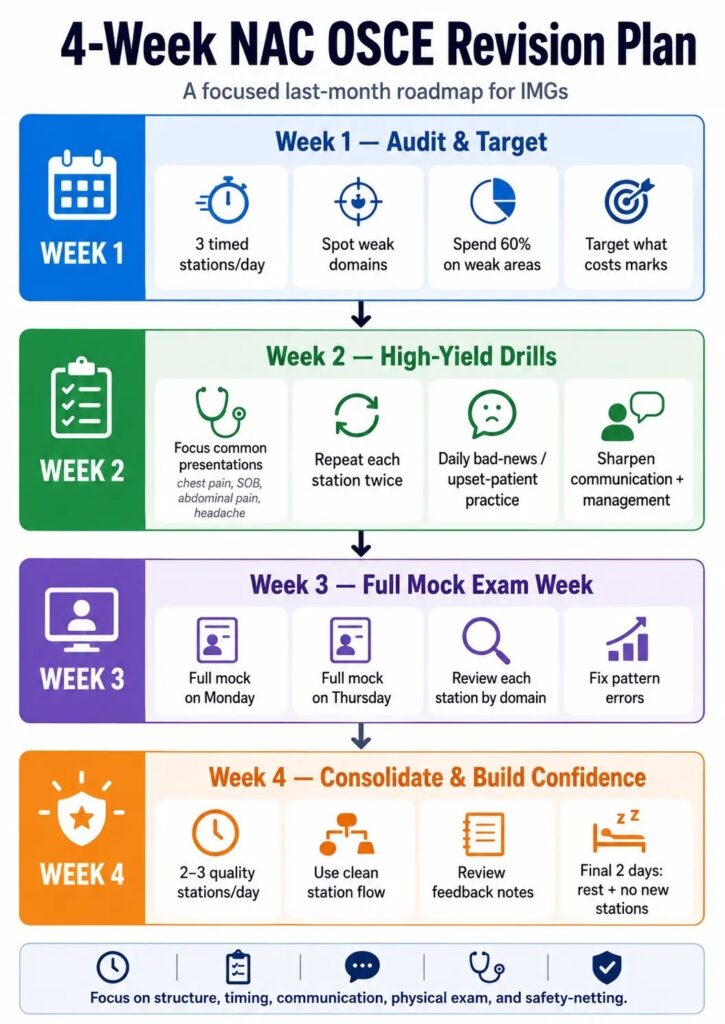
Last-Month NAC OSCE Revision Plan (4 Weeks)
Use this plan if your exam is 4 weeks away and your fundamentals are already in place.
How Jallah Academy Helps IMGs Prepare for NAC OSCE
Jallah Academy helps IMGs prepare for the NAC OSCE through structured, Canada-specific clinical exam training.
Structured NAC OSCE Preparation
Jallah Academy offers a 6-month program with live online sessions, delivered 3 days per week for 3 hours per session. The course also includes an optional in-person physical examination component in the final two weeks.
| Month | Main Focus | What Students Learn |
| Month 1 | OSCE Foundation | NAC OSCE format, Canadian clinical culture, examiner expectations, consent, confidentiality, empathy, professionalism, time management, ICE, Calgary-Cambridge, and SPIKES |
| Month 2 | Focused History Taking | Structured histories for chest pain, shortness of breath, abdominal pain, headache, dizziness, psychiatry, obstetrics, gynecology, and pediatrics |
| Month 3 | Physical Examination Skills | Cardiovascular, respiratory, abdominal, neurological, and musculoskeletal examinations with consent, positioning, hand hygiene, patient comfort, examiner narration, and findings summary |
| Month 4 | Integrated Clinical Stations | History, physical examination, communication, differential diagnosis, investigations, management, red flags, and escalation |
| Month 5 | Ethics and Difficult Conversations | Capacity, consent, mandatory reporting, error disclosure, end-of-life discussions, conflict resolution, and distressed patient encounters |
| Month 6 | Final Exam Readiness | High-yield station patterns, back-to-back cases, stress management, exam-day strategy, and optional physical examination refinement |
Mock OSCEs, Simulation, and Feedback
Jallah Academy offers optional mock OSCEs at the end of Month 2 and Month 4, plus a final full NAC OSCE simulation at the end of Month 6.
These mock exams require separate registration and payment and are not included in standard membership.
Each mock exam includes timed OSCE stations, standardized patient encounters, examiner-style checklists, individualized feedback, and remediation guidance.
NAC OSCE Cases, Notes, Videos, and Class Support
Jallah Academy provides study resources for repeated practice. The Basic NAC OSCE subscription includes 200 cases/notes and lecture videos.
The Advanced NAC OSCE subscription includes NAC OSCE notes, lecture recordings, videos, and 3 sessions per week lasting 2 – 3 hours.
Live classes add accountability and direction. Regular sessions help students follow a preparation schedule, ask questions, and build discipline throughout the study period.
Mentorship and IMG-Focused Guidance
Jallah Academy supports IMGs beyond course content.
The academy describes itself as a global learning community founded by Dr. Mohammad Nasir Jallah, with a focus on exam preparation for IMGs pursuing Canadian medical licensure.
Its services include online and in-person classes, one-on-one mentoring, crash courses, physical examination training, video lectures, and educational support.
Jallah Academy’s membership page invites students to book a free consultation if they are unsure which package to choose or need a proper study plan.
This is useful for IMGs who feel overwhelmed, have limited time, or do not know how to organize their NAC OSCE preparation.
Expected Learning Outcomes for Students
Jallah Academy aims to build exam-ready NAC OSCE performance.
By the end of the program, students are expected to perform structured NAC OSCE histories and examinations, communicate clearly and professionally, demonstrate Canadian-standard clinical reasoning, handle ethical and challenging stations, and enter the NAC OSCE prepared.
NAC OSCE Tips for Exam Day
Here are a few tips to make the NAC OSCE exam day a bit relaxing for you.
1. Arrive Prepared With Required Items
The Medical Council of Canada lists a plain white lab coat, stethoscope, printed Entrance Card, and printed, signed Candidate Confidentiality Agreement page as required items for the NAC Examination.
Candidates more than 15 minutes late for registration may be denied entry.
2. Read the Door Prompt Carefully
Prompt reading controls your station strategy. The door instructions may include the patient’s name, age, setting, presenting problem, vital signs, test results, family history, and the type of station.
3. Use a Simple Station Flow
Open professionally, confirm identity, explain your role, ask consent, complete the task, summarize key findings, explain next steps, check understanding, and close safely.
4. Manage Time and Stay Composed
Time control protects your 11 minutes. The MCC allows 2 minutes to move and read instructions, but the station still lasts 11 minutes from the signal, even if you enter late.
5. Narrate Physical Examination Stations
The MCC says candidates should state what manoeuvres they are doing, what findings they are looking for, and describe relevant findings during physical examination stations.
6. Close Every Station Safely
Summarize the issue, explain the plan, invite questions, check understanding, and give safety-net advice when relevant.
7. Recover Quickly After Mistakes
Leave each station behind after the final signal. Use the 2-minute transition to breathe, reset, read the next prompt, and start again with a clear plan.
FAQs
1. How should IMGs prepare for the NAC OSCE?
IMGs should prepare with timed station practice, mock OSCEs, focused histories, physical examination drills, and patient-centred communication. Strong preparation should include Canadian clinical expectations, structured station flow, counselling practice, feedback review, and safety-netting.
2. What skills does the NAC OSCE test?
The NAC OSCE candidates may be assessed on history taking, diagnosis, management, communication, physical examination, investigations, and data interpretation.
3. What are common NAC OSCE mistakes IMGs make?
Common NAC OSCE mistakes include poor time management, weak closure, limited empathy, unfocused history taking, unclear management plans, and silent physical examination performance.
4. How important is communication in the NAC OSCE?
Communication is essential in the NAC OSCE. Candidates must build trust, use plain language, listen actively, show empathy, check understanding, and involve the patient in the plan.
Final Thoughts
For most IMGs, passing the NAC OSCE takes more than strong medical knowledge.
The exam also tests how well you communicate with patients, take focused histories, perform physical examinations, manage your time, and make safe clinical decisions in a Canadian healthcare setting.
The best way to prepare is working through timed stations, reviewing feedback, and repeating common cases.
Jallah Academy supports IMGs with structured NAC OSCE preparation, including online classes, a large case library, lecture videos, physical examination training, mock practice sessions, personalized feedback, and mentorship.
Ready to prepare for the NAC OSCE with structured guidance? Explore Jallah Academy’s NAC OSCE preparation program!
