
What Is Medical Residency in Canada?
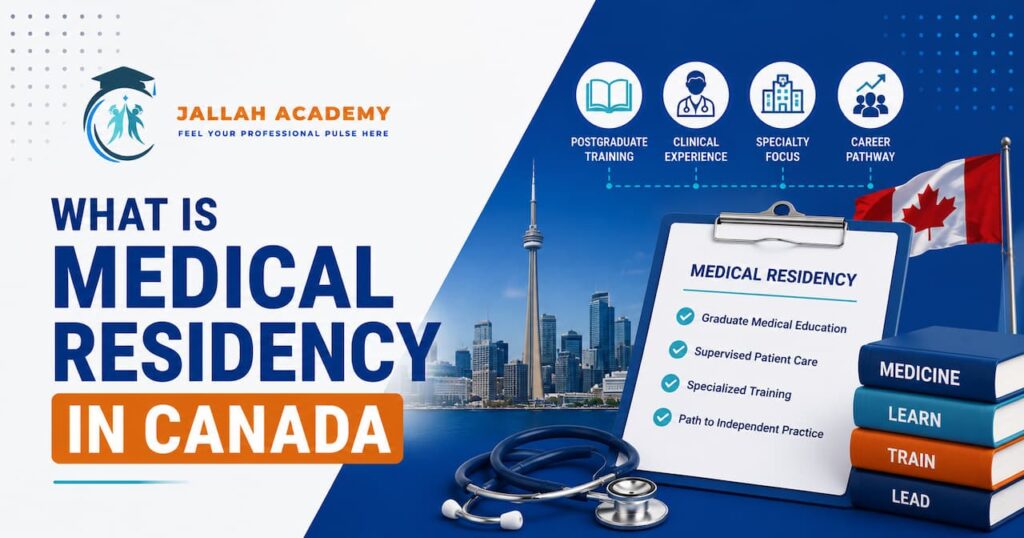
Medical residency is the training period every doctor must complete after finishing medical school before they’re allowed to practice medicine independently. It’s not optional. Without completing a residency, a medical degree alone does not give you the right to see and treat patients on your own in Canada. During residency, you work as a resident physician, seeing real patients, making clinical decisions, and performing procedures, all under the supervision of fully licensed attending physicians. You’re a working doctor, but not yet an independent one. Why Residency Exists Medical school gives you the knowledge base. Residency is where you develop the judgment and specialty-specific skills to apply it safely in real clinical settings. Think of it this way: you can study surgery from a textbook, but you can’t become a surgeon without years of supervised operating experience. The same applies in every specialty, whether that’s psychiatry, internal medicine, pediatrics, or radiology. Residency is also what leads to certification. In Canada, the two certifying bodies are the Royal College of Physicians and Surgeons of Canada (RCPSC), which oversees most medical and surgical specialties, and the College of Family Physicians of Canada (CFPC), which governs Family Medicine. Completing a residency program accredited by one of these bodies, and then passing their certification exams, is what gives you the right to practice independently and hold specialist status. What Residency Actually Looks Like Day to Day As a resident, you work clinical shifts in hospitals and outpatient settings alongside attending physicians. You take patient histories, order and interpret investigations, make diagnosis and treatment decisions, and perform procedures appropriate to your specialty and training year. Your first year, PGY-1 (postgraduate year 1), is the most general and closely supervised. As you advance through PGY-2, PGY-3, and beyond, your clinical responsibility grows and supervision becomes less hands-on. Residents in Canada are paid a salary, typically ranging from around $60,000 to $90,000 CAD annually depending on specialty and province, because you are a working physician, even while still in training. Residency vs Fellowship These two terms often cause confusion. Feature Residency Fellowship When it happens After medical school After completing residency Required? Yes, for all independent practice Optional, for subspecialization Leads to RCPSC or CFPC certification Subspecialty expertise Example Internal Medicine (4 years) Cardiology fellowship (2-3 years) Residency is mandatory. Fellowship is an optional next step for physicians who want to subspecialize beyond their core specialty. How the Canadian Residency System Works In Canada, residency positions are matched through CaRMS, the Canadian Resident Matching Service. This is a centralized application system that collects applications from graduates and matches them to available residency positions across the country based on both program and applicant rank-order lists. The match runs in two iterations. The first iteration separates Canadian medical graduates (CMGs) from international medical graduates (IMGs). CMGs apply for the large pool of general residency seats. IMGs apply for a smaller, designated pool of IMG-specific seats, which means you’re competing against other IMGs, not directly against Canadian grads. If seats remain unfilled after the first iteration, they go into a second iteration where IMGs and CMGs compete together for whatever’s left. The IMG Path to Residency in Canada If you earned your medical degree outside Canada (or in Canada but at an internationally-based school), you’re classified as an international medical graduate. To be eligible to apply through CaRMS, you need to meet several requirements: Canadian citizenship or permanent resident status. This is a hard requirement, not a preference. You cannot apply through the main CaRMS match without it. Passing the MCCQE1. The Medical Council of Canada Qualifying Examination Part 1 is required before you can apply. It’s a 100% multiple-choice exam covering clinical knowledge across all major specialties. Passing the NAC OSCE. The National Assessment Collaboration Objective Structured Clinical Examination tests your clinical skills in person, through 12 standardized patient stations. Both exams together demonstrate that your medical knowledge and clinical skills meet Canadian standards. Credential verification through physiciansapply.ca. Your medical degree and transcripts must be verified by the MCC before you can register for the exams or apply through CaRMS. The Practice-Ready Assessment Alternative If you’re an experienced physician who has already completed residency training and practiced independently in another country, you may not need to go through the full CaRMS match process. Several provinces, including British Columbia and Alberta, offer Practice-Ready Assessment (PRA) programs, which evaluate your clinical competence through a 12-week supervised workplace assessment rather than a full residency program. This pathway is designed for physicians with substantial post-residency experience. It’s not available to recent graduates. Some IMG-designated residency seats, particularly in BC, also come with a Return of Service obligation. This means accepting the position comes with a contractual commitment to practice in an underserved community or regional health authority for a set period after completing your residency. Starting the Journey the Right Way The pre-residency phase, getting through MCCQE1, NAC OSCE, and the CaRMS match, is the part of the process IMGs have the most control over. Exam scores are one of the clearest signals program directors use to evaluate IMG candidates, since they provide a standardized comparison point across very different educational backgrounds. At Jallah Academy, both the MCCQE1 Prep Course and the NAC OSCE Prep Course are built specifically for IMGs working through this pre-residency phase. The courses are structured around the current exam formats, taught through case-based learning and live classes, so you’re preparing for the actual exams in the way they test, not just reading through notes. After Residency Once you complete your residency and pass the RCPSC or CFPC certification exams, you receive your specialist designation and can apply for a full medical license in the province where you want to practice. At that point, you’re an independent physician. Some physicians go on to complete fellowship training for subspecialization. Others move directly into clinical practice, academic medicine, or research. Where you go from there depends on your specialty and what you want your career to look like. Final Thoughts Medical
How Long Is Medical Residency in Canada?
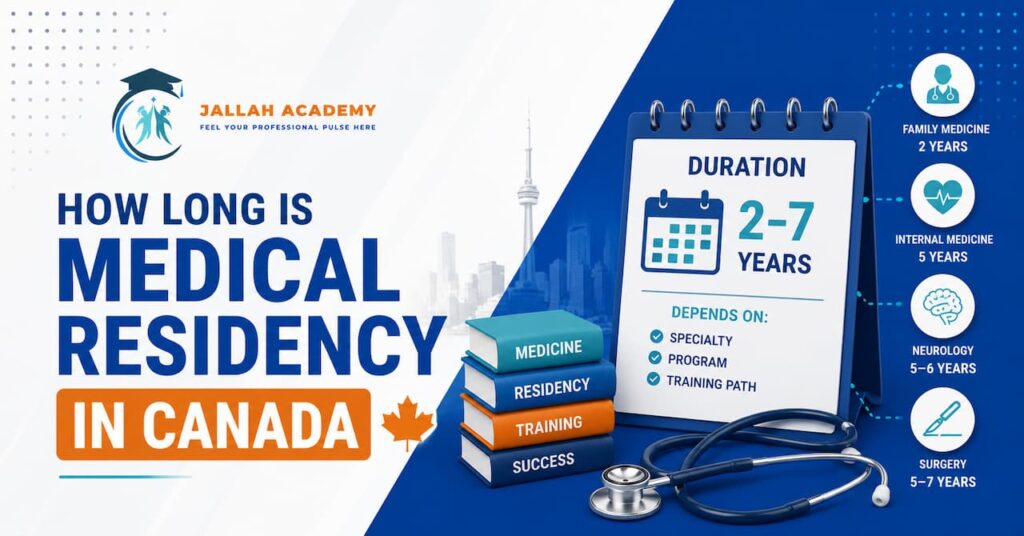
The short answer: it depends entirely on your specialty. Family Medicine is the shortest path at 2 years, while surgical subspecialties can stretch past 6 or 7 years. Let’s break down exactly what each path looks like, and a major change coming in 2027 that you should know about. The PGY System, Explained Simply Canadian residency is structured in postgraduate years, written as PGY-1, PGY-2, and so on. Each year builds on the last, with increasing clinical responsibility. PGY-1 is your first year out of medical school, and the total number of PGY years depends entirely on which specialty you matched into. Residency Length by Specialty Here’s a practical breakdown of how long each path actually takes: Specialty Residency Length Family Medicine 2 years (becoming 3 years from 2027) Internal Medicine 4 years Pediatrics 4 years Psychiatry 5 years General Surgery 5 years Obstetrics and Gynecology 5 years Emergency Medicine 5 years Anesthesiology 5 years Diagnostic Radiology 5 years Neurosurgery 6 to 7 years Plastic Surgery 6 to 7 years Cardiac Surgery 6 to 7 years Subspecialty fellowships, things like cardiology, gastroenterology, or pediatric nephrology, are completed after core residency and typically add another 1 to 3 years on top. A Major Change Coming: Family Medicine Is Becoming 3 Years Here’s something most guides on this topic haven’t caught up to yet. The College of Family Physicians of Canada is extending Family Medicine residency from 2 years to 3 years, with the first 3-year programs expected to roll out in 2027. The reasoning behind the change is preparing family doctors to manage increasingly complex patients, full-scope practice, emergency room coverage, and broader rural responsibilities that current 2-year training doesn’t fully cover. It’s a contested change. Some current residents and advocacy groups have raised concerns that adding a year could discourage students from choosing Family Medicine at a time when access to family doctors is already strained across the country. If you’re planning your specialty choice with this timeline in mind, it’s worth tracking how this rolls out as your application year approaches. Why Residency Length Varies So Much Longer programs generally reflect more complex procedural training. Surgical specialties need years of hands-on operating experience before a resident can practice independently and safely. Cognitive specialties like internal medicine or psychiatry still require years of supervised clinical judgment-building, but the procedural component is lighter, which is part of why their programs run shorter than surgical subspecialties. Family Medicine has historically been the shortest path because it’s designed as broad, generalist training rather than deep specialization in one organ system or procedure type. How This Looks Different for IMGs If you’re an international medical graduate, your residency length once matched is generally the same as a Canadian medical graduate’s in the same specialty. The bigger timeline difference happens before residency even starts. Before an IMG can even apply through CaRMS, you need to complete credential verification, pass the MCCQE1, pass the NAC OSCE, and go through the CaRMS application and match cycle itself. Realistically, this pre-residency phase adds 1 to 3 years on top of your eventual residency length, depending on how quickly you move through each exam and whether you match on your first attempt. So if you’re calculating your total timeline to independent practice in Canada, it’s not just “residency length.” It’s exam prep time, plus match cycle time, plus the residency program itself. Building Your Realistic Timeline If you’re an IMG mapping out your path, a rough total timeline looks like this: Pre-residency phase: 1 to 2 years for credential verification, MCCQE1, and NAC OSCE preparation, plus the CaRMS application cycle. Residency phase: 2 to 7 years depending on your matched specialty. Optional fellowship phase: 1 to 3 additional years if you’re subspecializing. The exam prep phase is the part you have the most control over. A focused, well-prepared first attempt at both MCCQE1 and NAC OSCE keeps your overall timeline as short as possible, since reapplying after an unsuccessful match cycle adds another full year to your journey. This is exactly where structured preparation pays off. At Jallah Academy, the MCCQE1 Prep Course and NAC OSCE Prep Course are both built specifically for IMGs working through this pre-residency phase, with case-based learning and live classes designed to get you exam-ready efficiently, so you’re not adding unnecessary years to an already long journey. Final Thoughts Residency length in Canada ranges from 2 years for Family Medicine to 7 years for the most specialized surgical fields, with the Family Medicine timeline set to grow to 3 years starting in 2027. For IMGs, the bigger variable isn’t residency length itself, it’s how efficiently you move through the pre-residency exam and match process. Plan for both, and you’ll have a realistic picture of your full path to practicing medicine in Canada.
Is It Hard to Get a Medical Residency in Canada? Here’s What the Numbers Actually Say
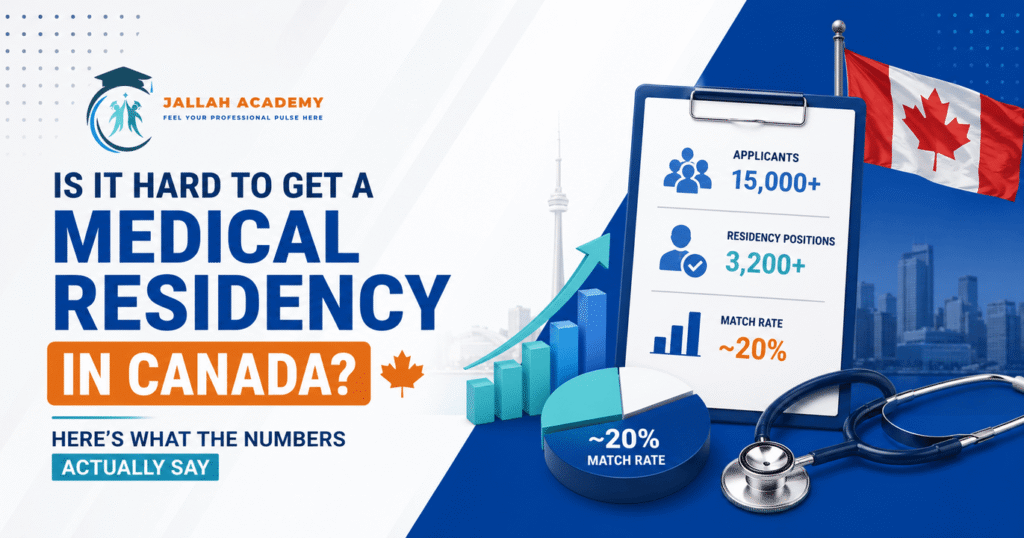
Short answer: yes, it’s hard. Especially if you’re an international medical graduate. But “hard” doesn’t mean impossible. Hundreds of IMGs match into Canadian residency programs every year. The real question isn’t whether it’s hard. It’s understanding exactly how hard, why, and what actually moves the needle for your application. Let’s look at the real numbers. The Match Numbers Recent Year In the 2025 CaRMS first iteration, the gap between Canadian medical graduates (CMGs) and international medical graduates (IMGs) was significant. Applicant Type Match Rate (First Iteration) CMG, current-year graduate 93.0% CMG, previous-year graduate 89.6% IMG, current-year graduate 77.2% IMG, previous-year graduate 43.2% That gap between current-year and previous-year IMGs matters a lot. If you don’t match in your first year of applying, your odds drop sharply with each additional attempt. This is one of the most overlooked facts in IMG residency planning. When you combine all years of IMG applicants together, the overall picture is tougher. Studies looking at multi-year IMG cohorts have found that fewer than a quarter of all IMG applicants ever successfully match, even across multiple attempts. Why It’s Harder for IMGs Specifically It comes down to seats. Canadian medical schools produce a fixed number of CMGs every year, and the vast majority of residency seats are reserved for them. IMGs compete for a much smaller pool of designated IMG seats. In Ontario, for example, the IMG applicant-to-position ratio is over 4 to 1. That means for every available seat, more than four IMGs are applying. On top of that, IMGs are evaluated separately from CMGs in most provinces. You’re not directly competing against Canadian grads for the same seat. You’re competing against other IMGs, but for far fewer total spots. The Ontario Policy Change You Should Know About Starting with the 2026 CaRMS cycle, Ontario introduced a policy requiring IMG applicants for designated Ontario seats to have completed at least two years of high school in Ontario, if they’re Canadian citizens or permanent residents. This policy is currently under a court injunction, so implementation is uncertain, but it signals where provincial policy is heading. This matters because it shows provinces actively shaping who gets priority access to IMG seats. If you’re applying from outside Canada with no Ontario educational ties, your strategy may need to lean more heavily on other provinces. Which Provinces Are More IMG-Friendly Not all provinces handle IMG applications the same way. Some have structured programs specifically built for IMGs: If you’re an experienced, already-licensed physician rather than a recent graduate, PRA pathways can be a faster route than the traditional CaRMS residency match. They typically require several years of independent practice experience and passing the MCCQE1 and NAC OSCE, but they let you skip repeating a full residency. What Separates Matched IMGs From Unmatched Ones This is the part most articles skip. Based on CaRMS data and consistent patterns across matched applicants, a few factors show up again and again: Strong exam scores. A passing MCCQE1 score is 226. Competitive applicants often score 260 or higher. Program directors use exam scores as one of the few standardized ways to compare candidates with very different educational backgrounds. Applying broadly. The average IMG applicant submits close to 20 program applications. Limiting yourself to one or two programs significantly lowers your odds. Matching in your first attempt. As the numbers show, your match probability drops substantially after your first cycle. Treat your first application year as the one that matters most. Specialty choice. Family Medicine, Psychiatry, and certain primary care fields tend to have comparatively higher IMG acceptance than competitive specialties like surgery or dermatology. Strong letters and a clear narrative. A well-written letter of intent and reference letters from clinicians who’ve actually observed your work carry real weight, especially when program directors are comparing candidates from vastly different health systems. The One Thing Within Your Control You can’t control how many IMG seats a province offers. You can’t control policy changes. But you can control how well-prepared you are for your exams, and exam performance is one of the clearest signals program directors use to evaluate IMG candidates. This is exactly where focused preparation makes a real difference. At Jallah Academy, the MCCQE1 Prep Course is built around the kind of high-yield, case-based learning that helps you move from a passing score toward a genuinely competitive one. With access to thousands of practice cases and live structured classes, you’re preparing the way that actually reflects how the exam tests you. The same applies to your clinical skills. The NAC OSCE Prep Course focuses on the communication and station performance skills that examiners and, indirectly, program directors are evaluating. A strong NAC OSCE result doesn’t just get you through the exam. It builds the clinical confidence that shows up in your interviews and your overall candidacy. Realistic Timeline Expectations Most IMGs spend one to three years completing the full process: credential verification, MCCQE1, NAC OSCE, and the CaRMS application cycle itself. If you don’t match on your first attempt, plan for the possibility of reapplying, while also exploring PRA pathways if you have sufficient clinical experience. Final Thoughts Getting a residency in Canada as an IMG is genuinely difficult. The numbers don’t sugarcoat that. But difficulty isn’t the same as impossibility, and the applicants who do match usually share a pattern: strong exam scores, broad and strategic applications, and a first-attempt mindset. You can’t change the system. You can control how prepared you walk into it. That’s where your time and effort are best spent.
NAC OSCE vs MCCQE1: What’s the Difference and Which Should You Prep First?
If you’re an IMG trying to get licensed in Canada, you’ve definitely heard these two names a lot. NAC OSCE. MCCQE1. Everyone talks about them. But not everyone explains them clearly, especially when it comes to which one to tackle first and how they actually differ. Let’s break it down in plain language. What Is the MCCQE1? The Medical Council of Canada Qualifying Examination Part 1, or MCCQE1, is a written, computer-based exam. It tests your medical knowledge across all core disciplines. Think internal medicine, surgery, pediatrics, psychiatry, ob-gyn, and more. It’s a knowledge exam. Multiple choice questions. Clinical decision-making cases. You sit at a computer, read scenarios, and pick answers. Key facts about MCCQE1: What Is the NAC OSCE? The National Assessment Collaboration Objective Structured Clinical Examination, NAC OSCE, is a hands-on clinical skills exam. You go from station to station, interact with standardized patients (real actors), and demonstrate real clinical skills. It’s not about picking the right answer. It’s about doing the right thing in real time. Key facts about NAC OSCE: Side-by-Side Comparison Feature MCCQE1 NAC OSCE Format Written / Computer-based In-person / OSCE stations Skills Tested Medical knowledge, reasoning Clinical skills, communication Duration ~4.5 hours ~3.5 hours Location Testing centers across Canada Select Canadian cities Frequency Multiple times a year Once a year Difficulty Focus Breadth of knowledge Applied clinical performance Study Style Reading, QBanks, practice cases Role-play, feedback, simulation The Big Question: Which One Should You Prep First? Short answer: MCCQE1 first, NAC OSCE second. Here’s why that usually makes sense. MCCQE1 Builds Your Foundation The MCCQE1 forces you to deeply review all your medical knowledge. When you study for it, you’re reinforcing clinical reasoning across every specialty. That same knowledge becomes your backbone when you face NAC OSCE stations. You already know the differential diagnoses. You already know the investigations and management steps. The NAC OSCE just asks you to deliver that knowledge out loud, in person. NAC OSCE Is More About Skill, Less About New Learning Most of what you need for the NAC OSCE, the medical content, you’ll have already covered while prepping for MCCQE1. What NAC OSCE prep focuses on is communication, structure, time management per station, and physical exam technique. That’s a specific layer you build on top of solid knowledge. Scheduling Reality NAC OSCE only runs once a year. MCCQE1 runs multiple times. So if you’re planning strategically, it’s safer to sit MCCQE1 first, pass it, then focus fully on NAC OSCE prep knowing your knowledge base is already certified. Can You Prepare for Both at the Same Time? Technically yes. And some people do it when their exam dates are close together. But it’s tough. The prep styles are very different. Written exam prep is desk work: reading, doing questions, reviewing notes. NAC OSCE prep is active: role-playing cases, getting feedback on your patient interaction, timing yourself at stations. If you try to do both simultaneously without a structured plan, you risk burning out or doing neither well. Having a coach or a structured program helps a lot here. What Makes NAC OSCE Harder for Most IMGs? Honestly? The communication part. The medical knowledge is there, you went to medical school. But delivering a full history, doing a focused physical exam, counseling a patient, and managing your time, all in 11 minutes, that’s a skill you need to practice repeatedly. Most IMGs underestimate this. They read about NAC OSCE, feel confident about the medical content, then walk in and freeze because they’ve never practiced with a real person under time pressure. This is exactly why simulation matters so much for NAC OSCE prep. How Jallah Academy Can Help Jallah Academy was built by Dr. Mohammad Nasir Jallah, an IMG who went through this exact journey himself. He passed the MCCQE (formerly MCCEE) and the NAC OSCE, got licensed in Canada, and then built a program to help other IMGs do the same. The academy offers dedicated preparation courses for both exams. For MCCQE1: The MCCQE1 Prep Course gives you access to over 6,000 practice cases, lecture notes, videos, and live evening classes Monday through Wednesday (8 to 11 PM EST). It’s structured to cover everything the exam tests, with clinical decision-making built in. For NAC OSCE: The NAC OSCE Prep Course covers all core subject areas, includes over 200 OSCE cases, and runs live classes Thursday through Saturday (8 to 11 PM EST). The focus is on building your station structure, communication style, and clinical confidence through practice and real feedback. And if you want to experience the real thing before exam day, Jallah Academy also runs NAC OSCE Simulation Exams and MCCQE1 Simulation Exams, giving you that high-pressure, exam-like environment where you can find your weak spots early. Final Thoughts Both exams are required. Both are passable. The key is knowing what each one is testing, prepping for them in the right order, and not underestimating the clinical performance side of NAC OSCE. MCCQE1 builds your knowledge. NAC OSCE is where you show your skills. Take them seriously, prep with the right support, and you’ll get through it. Hundreds of IMGs have done it before you, and they started exactly where you are right now.
