
IMG medical licensing Canada is the process that International Medical Graduates follow to become doctors in Canada.
International Medical Graduates (IMGs) can obtain medical licensure in Canada by passing the required Medical Council of Canada examinations, meeting provincial licensing requirements, and completing residency training when required.
Licensing pathways vary by province. Most IMGs must demonstrate language proficiency, verify credentials, and obtain certification before independent medical practice.
This guide provides a complete overview of the IMG medical licensing in Canada, including MCCQE preparation, NAC OSCE requirements, CaRMS applications, practice-ready assessment options, timeline expectations, and exam preparation tips.
Therefore, let’s get into it!
What Is IMG Medical Licensing Canada?
IMG medical licensing Canada means the process that International Medical Graduates follow to become eligible to practise medicine in Canada.
An International Medical Graduate, or IMG, is someone who completed medical school outside Canada and wants to enter the Canadian medical system.
Most IMGs need to verify their medical credentials, apply through official systems, pass the required Medical Council of Canada exams, and meet the rules of the province or territory where they want to work.
Through Medical Council of Canada services, IMGs can submit credentials for source verification, apply for exams, and share results with Canadian medical regulatory authorities.
Two major exams in this pathway are the MCCQE and the NAC Examination, also called the NAC OSCE.
The MCCQE assesses medical knowledge, clinical decision-making, and passing it is required for IMGs applying to Canadian residency programs.
The NAC OSCE tests the clinical skills, communication, and professional behaviours needed for entry into residency in Canada.
Many IMGs apply through CaRMS, match into a Canadian residency program, complete postgraduate training, and then move toward provincial registration.
In simple terms, IMG Medical Licensing Canada is a step-by-step process. It usually includes credential verification, MCC exams, possible NAC OSCE requirements, residency or PRA planning, and provincial medical registration.
Who Is Considered an International Medical Graduate in Canada?
An International Medical Graduate in Canada is a doctor or medical graduate who completed medical school outside Canada. IMGs are also known as foreign-trained doctors or internationally trained physicians.
You are usually considered an IMG if:
- You graduated from a medical school outside Canada.
- Your medical degree is from an international institution.
- You want to apply for Canadian residency or medical licensing.
- You need your credentials reviewed before practising medicine in Canada.
For Canadian recognition, the medical school usually must be listed in the World Directory of Medical Schools and have a Canada Sponsor Note.
Why IMGs Have Different Requirements
IMGs have different requirements because their medical education was completed outside the Canadian accreditation system. Canada must verify that their training, documents, and exam results meet local standards.
Common requirements for IMGs may include:
- Medical credential verification
- MCCQE Part I
- NAC OSCE
- Language proficiency
- CaRMS residency eligibility
- Provincial licensing requirements
CaRMS states that IMG applicants for the R-1 residency match generally need to pass the NAC Examination and the MCCQE Part I.
Step-by-Step: How IMGs Can Practise Medicine in Canada
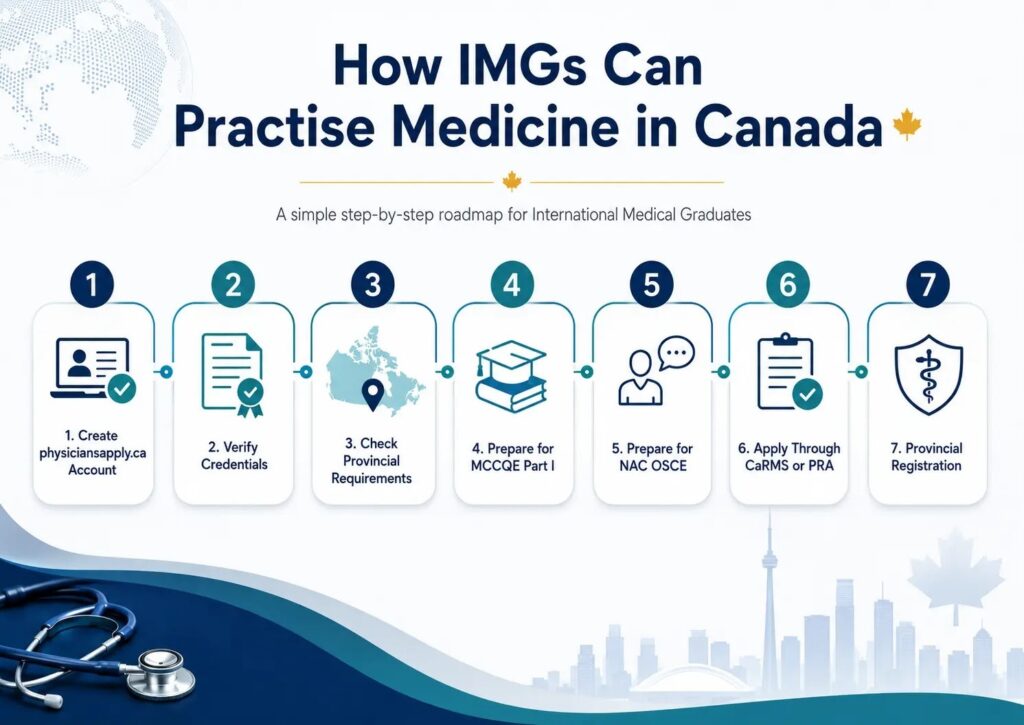
The exact steps can vary by province, so IMGs should always confirm requirements with the medical regulatory authority where they plan to work.
Step 1: Create a physiciansapply.ca Account
IMGs should first create a physiciansapply.ca account. This is the main online portal used to access Medical Council of Canada services.
Through physiciansapply.ca, candidates can apply for MCC exams, submit documents for source verification, view exam results, and share verified credentials with approved organizations.
Step 2: Verify Medical Credentials
IMGs must verify their medical credentials before moving forward in the licensing process. This confirms that their medical degree and other documents are authentic.
Step 3: Check Provincial Licensing Requirements
IMGs should check province-specific rules early. Canada has national exams, but each province and territory has its own medical regulatory authority.
This means the requirements for Ontario, Alberta, British Columbia, Manitoba, or another province may not be the same.
Step 4: Prepare for MCCQE Part I
IMGs usually need to prepare for the MCCQE Part I. This exam tests medical knowledge and clinical decision-making in a Canadian context.
Preparation should focus on clinical reasoning, ethics, public health, patient safety, and timed question practice.
For IMGs who need a clear study structure, Jallah Academy offers MCCQE1 preparation with live online and recorded sessions, case-based teaching, notes, lecture videos, and simulation-style practice.
Its MCCQE1 program is described as a 6-month course with 3 classes per week and 9 hours of weekly instruction.
Step 5: Prepare for NAC OSCE
Many IMGs also need the NAC OSCE, especially if they plan to apply for Canadian residency through CaRMS.
The NAC OSCE tests clinical skills such as history taking, communication, physical examination, diagnosis, management, and professionalism.
Jallah Academy’s NAC OSCE preparation covers OSCE foundations, history taking, communication skills, physical examination, ethics, professionalism, challenging stations, and Canadian clinical culture.
Step 6: Apply Through CaRMS or Explore PRA
Most IMGs apply for residency through CaRMS, the Canadian Resident Matching Service. This is the main residency matching system in Canada.
Some experienced doctors may explore Practice-Ready Assessment, also called PRA. PRA is usually for physicians who already have independent clinical experience and meet province-specific requirements.
Step 7: Apply for Provincial Medical Registration
The final licensing decision comes from the province or territory. After exams, residency, PRA, or other required steps, IMGs must apply to the medical regulatory authority where they want to practise.
MCCQE for IMGs: Format, Purpose, and Preparation
The MCCQE is one of the main exams International Medical Graduates need for medical licensing or residency in Canada.
It tests if candidates can apply medical knowledge, make safe clinical decisions, and work at the level expected of a medical graduate entering supervised practice.
Quick MCCQE Overview
| MCCQE Detail | What IMGs Should Know |
| Full name | Medical Council of Canada Qualifying Examination |
| Main purpose | Tests medical knowledge and clinical decision-making |
| Question type | Multiple-choice questions |
| Total questions | 230 MCQs |
| Exam sections | 2 sections |
| Questions per section | 115 MCQs |
MCCQE Format and Question Style
The MCCQE is a one-day computer-based exam with 230 multiple-choice questions. The exam is divided into two sections, with 115 questions in each section.
Each section includes pilot questions, but candidates will not know which questions are pilot questions during the exam.
The questions are usually based on clinical situations. Candidates may need to choose the most likely diagnosis, the best next test, the safest treatment, or the most appropriate management step.
This is why case-based practice is important. Jallah Academy’s MCCQE1 preparation emphasizes Canadian-style clinical reasoning, safe next-step thinking, ethics, public health, and exam-style practice instead of memorization alone.
How IMGs Should Prepare for MCCQE
IMGs should prepare for MCCQE with clinical reasoning practice, not memorization alone.
For MCCQE preparation, IMGs should spend time practising timed multiple-choice questions, strengthening their clinical reasoning skills, and reviewing key topics such as ethics, professionalism, public health, patient safety, and Canadian-style clinical cases.
Case-based learning can help because the MCCQE rewards decision-making.
NAC OSCE for IMGs: Format, Skills, and Common Challenges
The NAC OSCE is a clinical skills exam for International Medical Graduates who want to apply for Canadian residency.
It checks if IMGs can assess patients, communicate clearly, and make safe clinical decisions in a Canadian medical setting.
The NAC Examination is important for IMGs because it is used for entry into Canadian residency through CaRMS.
Quick NAC OSCE Overview
| NAC OSCE Detail | What IMGs Should Know |
| Full name | National Assessment Collaboration Examination |
| Exam type | Objective Structured Clinical Examination |
| Main purpose | Assesses readiness for Canadian residency |
| Format | 12 stations |
| Scored stations | 10 stations |
| Pilot stations | 2 stations, not counted |
| Time per station | 11 minutes |
| Break between stations | 2 minutes |
| Other stations | 2 – 3 wait stations with no clinical task |
What Happens in a NAC OSCE Station?
Each NAC OSCE station starts with a short written case. The candidate then enters the station and completes a clinical task.
The task may involve taking a history, conducting or describing a physical examination, explaining a diagnosis, discussing management, or responding to a patient concern.
Jallah Academy supports this through NAC OSCE online classes, mock-style practice, examiner-style feedback, and optional physical-examination training.
How IMGs Should Prepare for NAC OSCE
IMGs should prepare for the NAC OSCE through regular practice in exam-like conditions rather than relying only on reading cases.
Effective preparation includes practising history-taking, physical examinations, patient communication, diagnosis, and management planning while working within strict time limits.
Receiving feedback from experienced instructors and repeating stations under pressure can help you improve your performance, build confidence, and move through stations more naturally on exam day.
How Much Does IMG Medical Licensing Canada Cost?
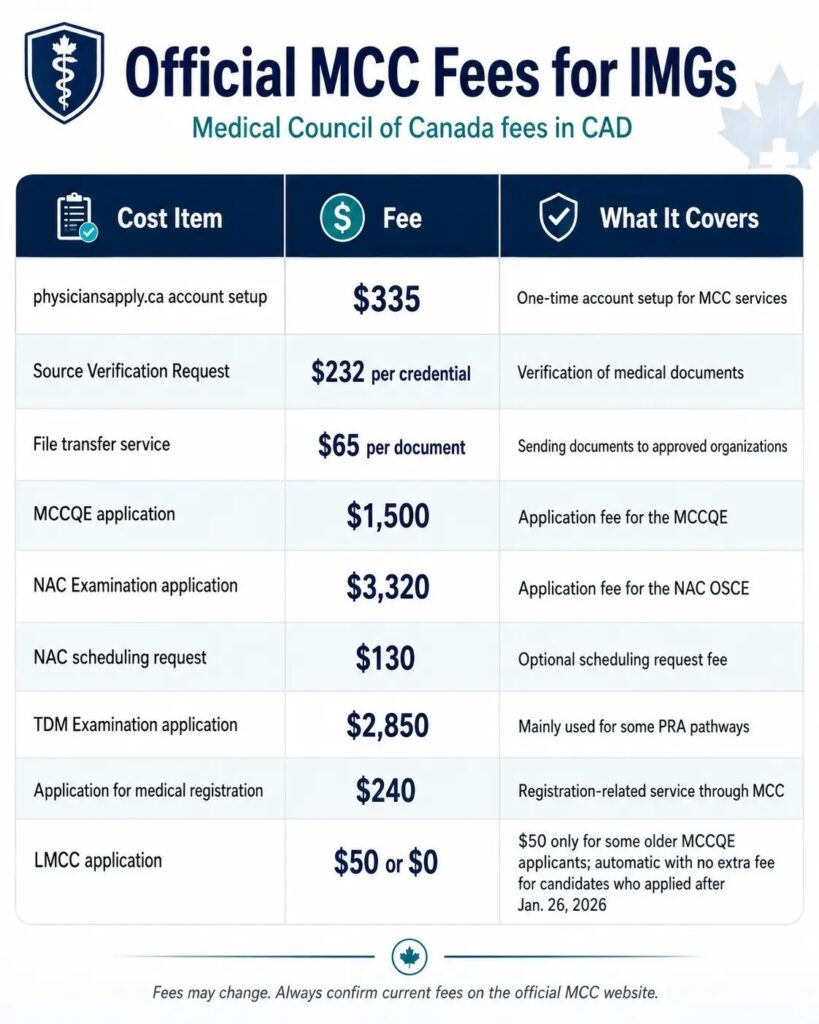
IMG medical licensing in Canada can cost more than CAD $5,000 before adding exam preparation, travel, translation, and provincial registration fees.
The main official costs usually include a physiciansapply.ca account, source verification, MCCQE, NAC Examination, and CaRMS application fees. We’ve added an estimate here below in the image. Please keep in mind it can vary over time and other conditions.
CaRMS Fees for Residency Applications
| CaRMS Cost Item | Fee | What It Covers |
| Match participation fee | $301.60 | Includes application to four programs |
| Extra program application fee | $64.96 per program | Applies after the first four programs |
| IMG verification fee | $133.94 | Required for applicants who did not graduate from a Canadian medical school |
Basic Cost Example for One IMG
A basic IMG cost estimate can reach CAD $5,822.54 before preparation, travel, translation, and provincial fees.
| Example Cost | Amount |
| physiciansapply.ca account | $335 |
| One source verification request | $232 |
| MCCQE application | $1,500 |
| NAC Examination application | $3,320 |
| CaRMS match participation fee | $301.60 |
| CaRMS IMG verification fee | $133.94 |
| Estimated subtotal | $5,822.54 |
IMG Medical Licensing Timeline in Canada
The IMG medical licensing timeline in Canada can take several months to several years.
The timeline depends on credential verification, MCCQE preparation, NAC OSCE preparation, CaRMS match timing, PRA eligibility, and the province where the IMG wants to practise.
Estimated Timeline for IMGs in Canada
| Stage | Estimated Time |
| Create physiciansapply.ca account | Days to weeks |
| Verify medical credentials | 3+ months |
| Prepare for MCCQE | 3 – 12+ months |
| Prepare for NAC OSCE | 2 – 6+ months |
| Apply through CaRMS | One match cycle or more |
| Provincial registration | Weeks to months |
CaRMS Can Add Waiting Time
CaRMS can add months because residency applications follow fixed match cycles. If an IMG misses an exam deadline, document deadline, or application window, they may need to wait for the next cycle.
PRA May Be Faster, But Not for Everyone
Practice-Ready Assessment, or PRA, may be faster for some experienced physicians. This pathway is usually for IMGs who have already completed postgraduate training and have independent practice experience outside Canada.
Common Mistakes IMGs Make During Canadian Licensing
Here are some common mistakes the IMGs need to avoid to achieve a smoother path for IMG medical licensing Canada.
1. Ignoring Provincial Licensing Rules
Each province and territory in Canada has its own medical regulatory authority, and candidates must check the rules for the province where they want to practise.
What to do instead: Choose your target province early and review its medical regulatory authority requirements before planning exams, costs, or timelines.
2. Delaying Credential Verification
IMGs should start credential verification as early as possible. Verified credentials may be needed for exams, residency applications, and provincial registration.
What to do instead: Use physiciansapply.ca early and begin source verification before exam or CaRMS deadlines get close.
3. Studying Without MCC Objectives
The MCC Examination Objectives guide the development of questions for both the MCCQE and NAC Examination.
What to do instead: Use the MCC Objectives as your study map. Focus on clinical presentations, decision-making, ethics, communication, public health, and patient safety.
4. Using Only Non-Canadian OSCE Material
IMGs should avoid preparing for NAC OSCE with only OSCE material from another country. The NAC Examination tests readiness for entry into Canadian residency and is required for IMGs applying to CaRMS.
What to do instead: Practise Canadian-style OSCE stations with timed cases, physical exam flow, clear counselling, and feedback.
Jallah Academy’s NAC OSCE preparation uses communication frameworks such as ICE, Calgary-Cambridge, and SPIKES to help candidates communicate more clearly in OSCE stations.
5. Underestimating the Total Cost
The full cost may include source verification, MCCQE, NAC OSCE, exam preparation, document sharing, travel, application fees, and possible retakes.
What to do instead: Include official fees, preparation costs, travel, and backup costs.
6. Checking CaRMS Eligibility Too Late
CaRMS eligibility can depend on citizenship or permanent resident status, medical school recognition, exam results, and provincial criteria.
What to do instead: Check CaRMS requirements early and confirm province-specific eligibility before applying.
7. Practising Without Exam Simulation
MCCQE and NAC OSCE both require performance under time pressure.
What to do instead: Use timed MCQ blocks for MCCQE. Use mock OSCE stations, examiner-style feedback, and repeated practice for NAC OSCE.
Jallah Academy offers MCCQE1 simulation exams, NAC OSCE mock-style practice, performance review, and physical-exam training.
Its MCCQE1 simulation is designed to reflect the official exam environment, timing, question style, and pressure, while its NAC OSCE support helps candidates practise station flow, verbalization, communication, and examiner-style expectations.
How Jallah Academy Supports IMGs Preparing for Canadian Licensing?
Jallah Academy supports International Medical Graduates by offering Canada-focused preparation for MCCQE1 and NAC OSCE.
This academy focuses on these areas through structured classes, case-based learning, mock-style practice, physical-exam training, and mentorship.
Its main programs focus on MCCQE1 preparation and NAC OSCE preparation, two important steps for many candidates pursuing residency or medical registration in Canada.
MCCQE1 Preparation at Jallah Academy
Jallah Academy’s MCCQE1 preparation is designed for IMGs seeking a clear study structure and Canadian-style clinical reasoning practice.
The program is described as a 6-month course with live online and recorded sessions, 3 classes per week, 3 hours per session, and 9 hours of instruction per week.
The MCCQE1 curriculum covers major exam areas such as internal medicine, cardiology, respirology, gastroenterology, endocrinology, rheumatology, orthopedics, surgery, emergency medicine, family medicine, obstetrics, gynecology, pediatrics, psychiatry, geriatrics, ethics, public health, and final integration.
Jallah Academy emphasizes case-based learning instead of memorization. It helps students practise clinical decision-making, Canadian exam logic, ethics, public health, and safe next-step thinking.
The academy provides the MCCQE1 students access to 6,000+ cases, notes, and lecture videos. They also offer a paid MCCQE1 Simulation Exam.
This simulation is designed to reflect the official exam environment, timing, question style, and pressure.
Listed pricing is $200 for new students and $75 for current students.
NAC OSCE Preparation at Jallah Academy
Jallah Academy’s NAC OSCE preparation is built for IMGs who need practical OSCE skills.
The program is described as a 6-month comprehensive course with live online sessions, 3 days per week, 3 hours per session, and 9 hours of weekly instruction.
It also includes an optional in-person physical examination component in the final two weeks.
The NAC OSCE curriculum covers OSCE foundations, communication skills, history taking, physical examination, integrated clinical stations, ethics and professionalism, challenging stations, final integration, and optional hands-on physical-exam practice.
Jallah Academy helps students practise communication, station structure, diagnosis, management, physical examination, Canadian clinical culture, and professionalism.
The program also uses communication frameworks such as ICE, Calgary-Cambridge, and SPIKES. They also offer NAC OSCE online classes with access to 200+ NAC OSCE cases, notes, and videos.
The listed online class schedule is on Thursday, Friday, and Saturday from 8 – 11 PM EST.
Physical-Exam and Mock OSCE Support
Jallah Academy offers a 2-week NAC OSCE Physical Examination Bootcamp focused on hands-on training.
It includes in-person practice, direct faculty feedback, small-group correction, time management, expert verbalization, examiner expectations, and marking schemes.
FAQs
Can IMGs practise medicine in Canada?
Yes, IMGs can practise medicine in Canada, but they must meet Canadian licensing requirements first. This usually includes credential verification, MCC exams, residency or an approved practice-ready pathway.
What exams do IMGs need for medical licensing in Canada?
Most IMGs need the MCCQE and NAC OSCE, especially if they plan to apply for Canadian residency through CaRMS. The exact exam requirements can vary by province and pathway.
Is the NAC OSCE mandatory for all IMGs?
Not always. The NAC OSCE is commonly required for IMGs applying to Canadian residency programs through CaRMS. However, some licensing pathways for experienced physicians may have different assessment requirements.
Can a foreign doctor work in Canada without repeating residency?
In some cases, yes, a foreign doctor can work in Canada without repeating residency. Experienced physicians may qualify for a Practice-Ready Assessment (PRA) program or other province-specific pathways that assess their competence without requiring a full Canadian residency.
Which provinces are considered IMG-friendly in Canada?
No province is officially “IMG-friendly,” but Saskatchewan, Manitoba, Nova Scotia, New Brunswick, and Newfoundland and Labrador are often seen as more accessible due to IMG/PRA pathways.
Can IMGs apply for medical residency in Canada?
Yes, eligible IMGs can apply for residency positions through the Canadian Resident Matching Service (CaRMS). Admission is competitive, and applicants are assessed based on exam results, academic history, and clinical experience.
Conclusion
IMG medical licensing Canada is a structured pathway that requires verified credentials, required exams, residency or PRA planning, and provincial medical registration.
IMGs need to understand how physiciansapply.ca, MCCQE, NAC OSCE, CaRMS, and provincial medical regulatory authorities connect before choosing their next step.
Start by verifying your medical credentials, reviewing MCC requirements, preparing for MCCQE and NAC OSCE, checking CaRMS eligibility, and confirming the rules in the province where you want to practise.
Ready to move forward with your Canadian medical licensing journey?
Explore Jallah Academy’s MCCQE1 and NAC OSCE preparation programs to get structured guidance, practical exam support, and IMG-focused mentorship.
