
What Is Medical Residency in Canada?
Medical residency is the training period every doctor must complete after finishing medical school before they’re allowed to practice medicine independently. It’s not optional. Without completing a residency, a medical degree alone does not give you the right to see and treat patients on your own in Canada. During residency, you work as a resident physician, seeing real patients, making clinical decisions, and performing procedures, all under the supervision of fully licensed attending physicians. You’re a working doctor, but not yet an independent one. Why Residency Exists Medical school gives you the knowledge base. Residency is where you develop the judgment and specialty-specific skills to apply it safely in real clinical settings. Think of it this way: you can study surgery from a textbook, but you can’t become a surgeon without years of supervised operating experience. The same applies in every specialty, whether that’s psychiatry, internal medicine, pediatrics, or radiology. Residency is also what leads to certification. In Canada, the two certifying bodies are the Royal College of Physicians and Surgeons of Canada (RCPSC), which oversees most medical and surgical specialties, and the College of Family Physicians of Canada (CFPC), which governs Family Medicine. Completing a residency program accredited by one of these bodies, and then passing their certification exams, is what gives you the right to practice independently and hold specialist status. What Residency Actually Looks Like Day to Day As a resident, you work clinical shifts in hospitals and outpatient settings alongside attending physicians. You take patient histories, order and interpret investigations, make diagnosis and treatment decisions, and perform procedures appropriate to your specialty and training year. Your first year, PGY-1 (postgraduate year 1), is the most general and closely supervised. As you advance through PGY-2, PGY-3, and beyond, your clinical responsibility grows and supervision becomes less hands-on. Residents in Canada are paid a salary, typically ranging from around $60,000 to $90,000 CAD annually depending on specialty and province, because you are a working physician, even while still in training. Residency vs Fellowship These two terms often cause confusion. Feature Residency Fellowship When it happens After medical school After completing residency Required? Yes, for all independent practice Optional, for subspecialization Leads to RCPSC or CFPC certification Subspecialty expertise Example Internal Medicine (4 years) Cardiology fellowship (2-3 years) Residency is mandatory. Fellowship is an optional next step for physicians who want to subspecialize beyond their core specialty. How the Canadian Residency System Works In Canada, residency positions are matched through CaRMS, the Canadian Resident Matching Service. This is a centralized application system that collects applications from graduates and matches them to available residency positions across the country based on both program and applicant rank-order lists. The match runs in two iterations. The first iteration separates Canadian medical graduates (CMGs) from international medical graduates (IMGs). CMGs apply for the large pool of general residency seats. IMGs apply for a smaller, designated pool of IMG-specific seats, which means you’re competing against other IMGs, not directly against Canadian grads. If seats remain unfilled after the first iteration, they go into a second iteration where IMGs and CMGs compete together for whatever’s left. The IMG Path to Residency in Canada If you earned your medical degree outside Canada (or in Canada but at an internationally-based school), you’re classified as an international medical graduate. To be eligible to apply through CaRMS, you need to meet several requirements: Canadian citizenship or permanent resident status. This is a hard requirement, not a preference. You cannot apply through the main CaRMS match without it. Passing the MCCQE1. The Medical Council of Canada Qualifying Examination Part 1 is required before you can apply. It’s a 100% multiple-choice exam covering clinical knowledge across all major specialties. Passing the NAC OSCE. The National Assessment Collaboration Objective Structured Clinical Examination tests your clinical skills in person, through 12 standardized patient stations. Both exams together demonstrate that your medical knowledge and clinical skills meet Canadian standards. Credential verification through physiciansapply.ca. Your medical degree and transcripts must be verified by the MCC before you can register for the exams or apply through CaRMS. The Practice-Ready Assessment Alternative If you’re an experienced physician who has already completed residency training and practiced independently in another country, you may not need to go through the full CaRMS match process. Several provinces, including British Columbia and Alberta, offer Practice-Ready Assessment (PRA) programs, which evaluate your clinical competence through a 12-week supervised workplace assessment rather than a full residency program. This pathway is designed for physicians with substantial post-residency experience. It’s not available to recent graduates. Some IMG-designated residency seats, particularly in BC, also come with a Return of Service obligation. This means accepting the position comes with a contractual commitment to practice in an underserved community or regional health authority for a set period after completing your residency. Starting the Journey the Right Way The pre-residency phase, getting through MCCQE1, NAC OSCE, and the CaRMS match, is the part of the process IMGs have the most control over. Exam scores are one of the clearest signals program directors use to evaluate IMG candidates, since they provide a standardized comparison point across very different educational backgrounds. At Jallah Academy, both the MCCQE1 Prep Course and the NAC OSCE Prep Course are built specifically for IMGs working through this pre-residency phase. The courses are structured around the current exam formats, taught through case-based learning and live classes, so you’re preparing for the actual exams in the way they test, not just reading through notes. After Residency Once you complete your residency and pass the RCPSC or CFPC certification exams, you receive your specialist designation and can apply for a full medical license in the province where you want to practice. At that point, you’re an independent physician. Some physicians go on to complete fellowship training for subspecialization. Others move directly into clinical practice, academic medicine, or research. Where you go from there depends on your specialty and what you want your career to look like. Final Thoughts Medical
How Long Is Medical Residency in Canada?
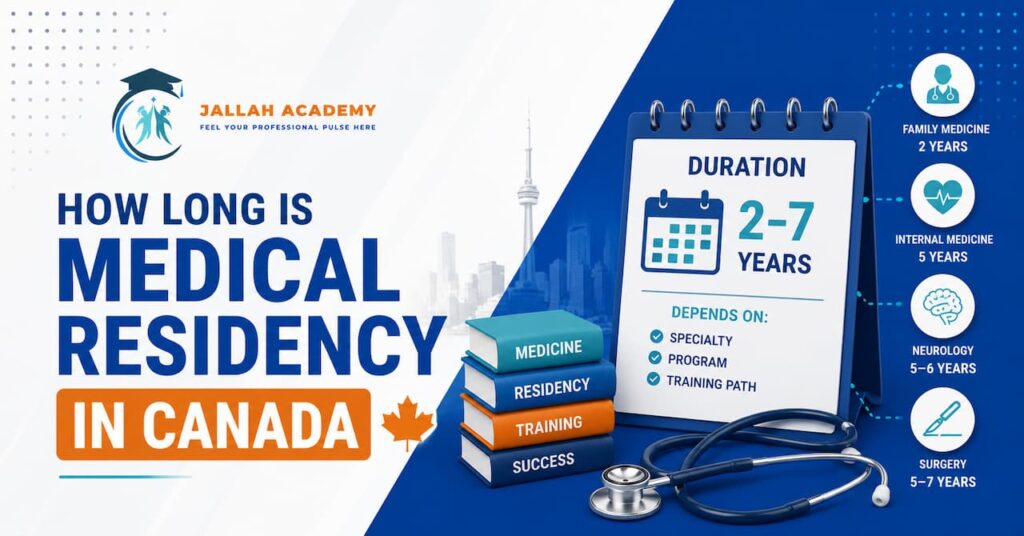
The short answer: it depends entirely on your specialty. Family Medicine is the shortest path at 2 years, while surgical subspecialties can stretch past 6 or 7 years. Let’s break down exactly what each path looks like, and a major change coming in 2027 that you should know about. The PGY System, Explained Simply Canadian residency is structured in postgraduate years, written as PGY-1, PGY-2, and so on. Each year builds on the last, with increasing clinical responsibility. PGY-1 is your first year out of medical school, and the total number of PGY years depends entirely on which specialty you matched into. Residency Length by Specialty Here’s a practical breakdown of how long each path actually takes: Specialty Residency Length Family Medicine 2 years (becoming 3 years from 2027) Internal Medicine 4 years Pediatrics 4 years Psychiatry 5 years General Surgery 5 years Obstetrics and Gynecology 5 years Emergency Medicine 5 years Anesthesiology 5 years Diagnostic Radiology 5 years Neurosurgery 6 to 7 years Plastic Surgery 6 to 7 years Cardiac Surgery 6 to 7 years Subspecialty fellowships, things like cardiology, gastroenterology, or pediatric nephrology, are completed after core residency and typically add another 1 to 3 years on top. A Major Change Coming: Family Medicine Is Becoming 3 Years Here’s something most guides on this topic haven’t caught up to yet. The College of Family Physicians of Canada is extending Family Medicine residency from 2 years to 3 years, with the first 3-year programs expected to roll out in 2027. The reasoning behind the change is preparing family doctors to manage increasingly complex patients, full-scope practice, emergency room coverage, and broader rural responsibilities that current 2-year training doesn’t fully cover. It’s a contested change. Some current residents and advocacy groups have raised concerns that adding a year could discourage students from choosing Family Medicine at a time when access to family doctors is already strained across the country. If you’re planning your specialty choice with this timeline in mind, it’s worth tracking how this rolls out as your application year approaches. Why Residency Length Varies So Much Longer programs generally reflect more complex procedural training. Surgical specialties need years of hands-on operating experience before a resident can practice independently and safely. Cognitive specialties like internal medicine or psychiatry still require years of supervised clinical judgment-building, but the procedural component is lighter, which is part of why their programs run shorter than surgical subspecialties. Family Medicine has historically been the shortest path because it’s designed as broad, generalist training rather than deep specialization in one organ system or procedure type. How This Looks Different for IMGs If you’re an international medical graduate, your residency length once matched is generally the same as a Canadian medical graduate’s in the same specialty. The bigger timeline difference happens before residency even starts. Before an IMG can even apply through CaRMS, you need to complete credential verification, pass the MCCQE1, pass the NAC OSCE, and go through the CaRMS application and match cycle itself. Realistically, this pre-residency phase adds 1 to 3 years on top of your eventual residency length, depending on how quickly you move through each exam and whether you match on your first attempt. So if you’re calculating your total timeline to independent practice in Canada, it’s not just “residency length.” It’s exam prep time, plus match cycle time, plus the residency program itself. Building Your Realistic Timeline If you’re an IMG mapping out your path, a rough total timeline looks like this: Pre-residency phase: 1 to 2 years for credential verification, MCCQE1, and NAC OSCE preparation, plus the CaRMS application cycle. Residency phase: 2 to 7 years depending on your matched specialty. Optional fellowship phase: 1 to 3 additional years if you’re subspecializing. The exam prep phase is the part you have the most control over. A focused, well-prepared first attempt at both MCCQE1 and NAC OSCE keeps your overall timeline as short as possible, since reapplying after an unsuccessful match cycle adds another full year to your journey. This is exactly where structured preparation pays off. At Jallah Academy, the MCCQE1 Prep Course and NAC OSCE Prep Course are both built specifically for IMGs working through this pre-residency phase, with case-based learning and live classes designed to get you exam-ready efficiently, so you’re not adding unnecessary years to an already long journey. Final Thoughts Residency length in Canada ranges from 2 years for Family Medicine to 7 years for the most specialized surgical fields, with the Family Medicine timeline set to grow to 3 years starting in 2027. For IMGs, the bigger variable isn’t residency length itself, it’s how efficiently you move through the pre-residency exam and match process. Plan for both, and you’ll have a realistic picture of your full path to practicing medicine in Canada.
How to Study for MCCQE1: A Practical Study Plan for 2026
The MCCQE1 changed in 2025. If you’re reading guides that still mention Clinical Decision-Making cases or a passing score of 226, that information is outdated. Let’s start with what the exam actually looks like now, then build a study plan that works for it. What Changed in the MCCQE1 Format As of April 2025, the MCC permanently removed the Clinical Decision-Making (CDM) component. The exam is now 100% multiple-choice. Here’s the current format compared to the old one: Feature Old Format Current Format (2025 onward) Question Types MCQs + CDM cases 100% MCQs Total Questions ~210 MCQs + 38 CDM cases ~230 single-best-answer MCQs Exam Duration About 9 hours About 6.5 hours Sections Multiple, mixed format Two sections of 115 questions each Passing Score 226 (scale 100-400) 439 (scale 300-600) The shift to MCQ-only means the exam now leans heavily on clinical vignettes. You’re given a short patient scenario and asked to pick the most appropriate next step in diagnosis or management. There’s no more written CDM response to worry about, but the questions still test real clinical reasoning, not just recall. Step 1: Start With the MCC Examination Objectives Before you touch a question bank, read through the MCC Examination Objectives. This is the official document that outlines exactly what the exam tests, organized by Dimensions of Care and Physician Activities, framed around the CanMEDS roles. Most candidates skip this step and go straight to question banks. That’s a mistake. The objectives tell you what to prioritize, so your study time goes toward what the exam actually rewards, not just what’s familiar from medical school. Step 2: Build a Realistic Study Timeline Most candidates need 3 to 6 months of focused preparation, depending on how recently they’ve practiced clinically and how comfortable they are with the Canadian guidelines and standards. A simple framework that works well: Months 1 to 2: Core content review by body system. Internal medicine, surgery, pediatrics, obstetrics and gynecology, psychiatry. Study in blocks, not randomly. Month 3: Start daily question bank practice. Mix in topics you’ve already reviewed so you’re applying knowledge, not just reading it. Months 4 to 5: Full-length timed practice exams. Simulate the real 6.5-hour appointment so your stamina and pacing are ready. Final weeks: Review weak areas based on your practice exam analytics. Don’t introduce brand new material this close to your exam date. If you’re studying part-time alongside work, extend this to 5 to 6 months and keep a consistent weekly rhythm rather than cramming on weekends. Step 3: Use Active Recall, Not Passive Reading This is the single biggest shift most candidates need to make. Reading notes and highlighting textbooks feels productive, but it doesn’t build the kind of recall the exam actually tests. Active recall means testing yourself before you check the answer. A few ways to apply it: Research consistently shows active recall improves long-term retention far more than passive review. For an exam built on vignette-style clinical reasoning, this matters even more, since you need to retrieve and apply knowledge quickly under time pressure. Step 4: Practice With Vignette-Style Questions Daily Since the exam is now 100% MCQs built around clinical vignettes, your practice should mirror that exact format. Don’t rely only on textbook-style multiple choice questions. When working through practice questions: Daily, consistent question practice builds the pattern recognition you need on exam day far more effectively than occasional long study sessions. Step 5: Take Full-Length Practice Exams Simulating the real exam conditions matters. The appointment is about 6.5 hours, including two sections of 115 questions with an optional break. If your first time sitting for that long is on exam day, fatigue will hurt your performance. Schedule at least two or three full-length practice exams in the months leading up to your test date. Time yourself strictly, eliminate distractions, and treat it like the real thing. Common Mistakes to Avoid A few patterns show up consistently among candidates who struggle: Relying on memorization over clinical reasoning. The exam tests how you apply knowledge to a scenario, not whether you can recall isolated facts. Studying randomly instead of by body system. Jumping between unrelated topics makes it harder for your brain to build connections between related concepts. Skipping practice exam review. Taking a mock exam without carefully reviewing every wrong answer wastes most of its value. Ignoring ethics, public health, and Canadian-specific guidelines. These areas are smaller in volume but still tested, and many IMGs underprepare for them since they differ from their home country’s standards. How NAC OSCE Prep Connects to Your MCCQE1 Study If you’re an IMG, you’ll also need to pass the NAC OSCE. The good news is that your MCCQE1 preparation builds the clinical knowledge foundation you’ll use again for NAC OSCE stations. Differentials, investigations, and management plans you memorize for MCCQE1 vignettes are the same knowledge you’ll apply out loud during NAC OSCE patient encounters. This is exactly why structured, case-based learning works better than isolated qbank grinding. At Jallah Academy, the MCCQE1 Prep Course is built around over 6,000 practice cases aligned with the current MCC blueprint, paired with live evening classes that walk through clinical reasoning the way the exam actually tests it. Instead of studying in isolation, you’re working through cases with guidance, which reinforces the same active recall and vignette-based thinking the new exam format demands. And since MCCQE1 knowledge carries directly into your NAC OSCE prep, the NAC OSCE Prep Course is designed to build on that same foundation, helping you turn knowledge into confident, real-time clinical performance. Final Thoughts The MCCQE1 has changed, and your study approach should change with it. Focus on the MCC objectives first, build a realistic timeline, use active recall instead of passive review, and practice with vignette-style questions daily. Take full-length mocks seriously, and don’t underprepare for ethics and Canadian-specific guidelines. Study smart, stay consistent, and the exam becomes manageable. Thousands of IMGs have passed it before you using exactly this kind of structured approach.
Is It Hard to Get a Medical Residency in Canada? Here’s What the Numbers Actually Say
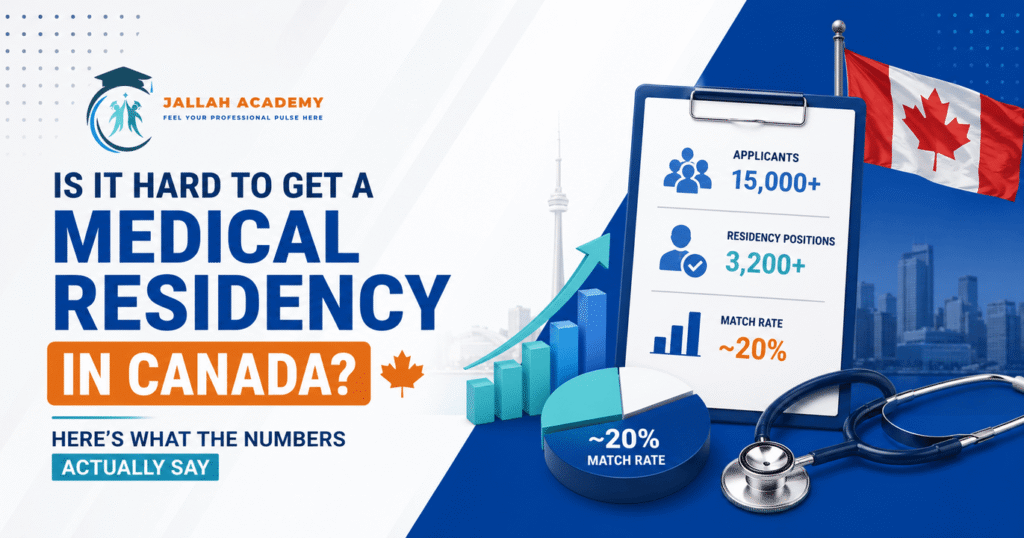
Short answer: yes, it’s hard. Especially if you’re an international medical graduate. But “hard” doesn’t mean impossible. Hundreds of IMGs match into Canadian residency programs every year. The real question isn’t whether it’s hard. It’s understanding exactly how hard, why, and what actually moves the needle for your application. Let’s look at the real numbers. The Match Numbers Recent Year In the 2025 CaRMS first iteration, the gap between Canadian medical graduates (CMGs) and international medical graduates (IMGs) was significant. Applicant Type Match Rate (First Iteration) CMG, current-year graduate 93.0% CMG, previous-year graduate 89.6% IMG, current-year graduate 77.2% IMG, previous-year graduate 43.2% That gap between current-year and previous-year IMGs matters a lot. If you don’t match in your first year of applying, your odds drop sharply with each additional attempt. This is one of the most overlooked facts in IMG residency planning. When you combine all years of IMG applicants together, the overall picture is tougher. Studies looking at multi-year IMG cohorts have found that fewer than a quarter of all IMG applicants ever successfully match, even across multiple attempts. Why It’s Harder for IMGs Specifically It comes down to seats. Canadian medical schools produce a fixed number of CMGs every year, and the vast majority of residency seats are reserved for them. IMGs compete for a much smaller pool of designated IMG seats. In Ontario, for example, the IMG applicant-to-position ratio is over 4 to 1. That means for every available seat, more than four IMGs are applying. On top of that, IMGs are evaluated separately from CMGs in most provinces. You’re not directly competing against Canadian grads for the same seat. You’re competing against other IMGs, but for far fewer total spots. The Ontario Policy Change You Should Know About Starting with the 2026 CaRMS cycle, Ontario introduced a policy requiring IMG applicants for designated Ontario seats to have completed at least two years of high school in Ontario, if they’re Canadian citizens or permanent residents. This policy is currently under a court injunction, so implementation is uncertain, but it signals where provincial policy is heading. This matters because it shows provinces actively shaping who gets priority access to IMG seats. If you’re applying from outside Canada with no Ontario educational ties, your strategy may need to lean more heavily on other provinces. Which Provinces Are More IMG-Friendly Not all provinces handle IMG applications the same way. Some have structured programs specifically built for IMGs: If you’re an experienced, already-licensed physician rather than a recent graduate, PRA pathways can be a faster route than the traditional CaRMS residency match. They typically require several years of independent practice experience and passing the MCCQE1 and NAC OSCE, but they let you skip repeating a full residency. What Separates Matched IMGs From Unmatched Ones This is the part most articles skip. Based on CaRMS data and consistent patterns across matched applicants, a few factors show up again and again: Strong exam scores. A passing MCCQE1 score is 226. Competitive applicants often score 260 or higher. Program directors use exam scores as one of the few standardized ways to compare candidates with very different educational backgrounds. Applying broadly. The average IMG applicant submits close to 20 program applications. Limiting yourself to one or two programs significantly lowers your odds. Matching in your first attempt. As the numbers show, your match probability drops substantially after your first cycle. Treat your first application year as the one that matters most. Specialty choice. Family Medicine, Psychiatry, and certain primary care fields tend to have comparatively higher IMG acceptance than competitive specialties like surgery or dermatology. Strong letters and a clear narrative. A well-written letter of intent and reference letters from clinicians who’ve actually observed your work carry real weight, especially when program directors are comparing candidates from vastly different health systems. The One Thing Within Your Control You can’t control how many IMG seats a province offers. You can’t control policy changes. But you can control how well-prepared you are for your exams, and exam performance is one of the clearest signals program directors use to evaluate IMG candidates. This is exactly where focused preparation makes a real difference. At Jallah Academy, the MCCQE1 Prep Course is built around the kind of high-yield, case-based learning that helps you move from a passing score toward a genuinely competitive one. With access to thousands of practice cases and live structured classes, you’re preparing the way that actually reflects how the exam tests you. The same applies to your clinical skills. The NAC OSCE Prep Course focuses on the communication and station performance skills that examiners and, indirectly, program directors are evaluating. A strong NAC OSCE result doesn’t just get you through the exam. It builds the clinical confidence that shows up in your interviews and your overall candidacy. Realistic Timeline Expectations Most IMGs spend one to three years completing the full process: credential verification, MCCQE1, NAC OSCE, and the CaRMS application cycle itself. If you don’t match on your first attempt, plan for the possibility of reapplying, while also exploring PRA pathways if you have sufficient clinical experience. Final Thoughts Getting a residency in Canada as an IMG is genuinely difficult. The numbers don’t sugarcoat that. But difficulty isn’t the same as impossibility, and the applicants who do match usually share a pattern: strong exam scores, broad and strategic applications, and a first-attempt mindset. You can’t change the system. You can control how prepared you walk into it. That’s where your time and effort are best spent.
Best Way to Memorize Medical Terminology (Especially If You’re Prepping for Exams)

Medical terminology feels impossible at first. Hundreds of words. Long, strange spellings. Latin roots, Greek suffixes, combinations you’ve never seen before. But here’s the thing: most people approach it the wrong way. They try to memorize each term individually, like flashcards with no system. That’s slow, stressful, and it doesn’t stick. There’s a smarter approach. And once you get it, everything becomes much easier. Why Medical Terminology Feels So Hard The problem isn’t that there are too many terms. The problem is that most people treat each term as a unique word to memorize. There are over 200,000 medical terms in English. You’re never going to memorize all of them one by one. But here’s what most people don’t realize: around 75% of those terms are built from the same Latin and Greek word parts. Learn the building blocks, and the rest starts to decode itself. The Most Important Technique: Learn Word Parts, Not Whole Words Every medical term has a structure. It’s made of three parts: Part Where It Appears What It Does Example Prefix Beginning of the word Modifies direction, location, quantity hyper-, hypo-, brady- Root Core of the word Carries the primary meaning (usually a body part) cardi (heart), hepat (liver), neph (kidney) Suffix End of the word Indicates condition, procedure, or specialty -itis (inflammation), -ectomy (removal), -ology (study of) Take the word “hepatitis.” Hepat means liver, and “itis” means inflammation. You’ve decoded it without ever memorizing the full word. Now you know that hepatomegaly means liver enlargement. That hepatectomy means liver removal. That hepatologist is a liver specialist. One root, five terms unlocked. This is the foundation. Everything else builds on top of it. Group Terms by Body System, Not Alphabetically A common mistake is studying medical terms in alphabetical order. That’s how dictionaries are organized, not how your brain works. Your brain retains information better when it sees patterns. So group your terms by body system: When you study a system together, the terms reinforce each other. You start seeing families of words, not isolated items to memorize. Use Spaced Repetition, Not Cramming Cramming the night before might get you through a quiz. It won’t get you through a licensing exam. Spaced repetition is the method where you review terms at increasing intervals. You see a term today, then in two days, then in a week, then in two weeks. Each time your brain recalls it successfully, it strengthens the memory. Anki is the most popular free app for this. You can find pre-made decks for medical terminology or build your own. Even 20 to 30 minutes daily for a few weeks will build a vocabulary base that actually sticks. Create Mnemonics for Terms That Don’t Decode Easily Not every medical term plays by the rules. Eponyms (terms named after people, like Cushing’s syndrome or Parkinson’s disease) and abbreviations won’t decode from word parts alone. For these, create a mnemonic or a short story. Something visual, something a little silly. The stranger the association, the better your brain holds onto it. For example, MUDPILES is a classic mnemonic for causes of high anion gap metabolic acidosis (Methanol, Uremia, Diabetic ketoacidosis, Propylene glycol, Isoniazid, Lactic acidosis, Ethylene glycol, Salicylates). IMGs preparing for the MCCQE1 already know this one. It’s exactly the kind of clinical shorthand that gets tested. Use Visuals When You Can Your brain stores most information as images, not text. When you learn a new root, picture it. For “osteo” (bone), picture a skeleton. For “derma” (skin), imagine skin texture. For “ophthalm” (eye), picture an eye. Attach the image to the root word, and recall becomes automatic over time. How This Connects to Your Exams If you’re preparing for the MCCQE1 or NAC OSCE, medical terminology isn’t just vocabulary. It’s clinical language you need to understand and use under pressure. The MCCQE1 tests you across all body systems. You’ll read clinical vignettes packed with terminology: presenting symptoms, lab findings, diagnosis names, and drug classes. If you’re stumbling over vocabulary, you’re losing time on questions. The NAC OSCE is even more direct. You’re talking to a standardized patient, taking a history, and managing a clinical case out loud. Using correct, confident clinical language signals competency to examiners. Fumbling over terms signals uncertainty, even when your clinical thinking is correct. Vocabulary mastery isn’t separate from exam prep. It’s part of it. At Jallah Academy, the MCCQE1 and NAC OSCE prep courses are built around active clinical application. You’re not just studying isolated facts. You’re using medical language in context, through case-based learning, live sessions, and practice under real exam conditions. That’s exactly the environment where your vocabulary gets reinforced naturally, not through rote memorization. A Simple Daily Study Framework You don’t need a complex schedule. You need consistency. Week 1 to 2: Master the 50 most common prefixes and 30 most common suffixes. Practice decoding 5 to 10 new terms daily. Week 3 to 4: Move through body systems one at a time. Cardiovascular, then respiratory, then digestive, and so on. Build a small Anki deck per system. Week 5 onward: Review through practice questions and clinical scenarios. Your terminology sticks when you see it in context, not in isolation. If you’re on a compressed timeline for the MCCQE1 or NAC OSCE, the MCCQE1 Prep Course at Jallah Academy covers over 6,000 clinical cases across all body systems. The terminology gets absorbed as you work through cases, which is a much more efficient approach than studying a word list separately. The Apps Worth Knowing None of these replace deep study. But used consistently alongside case-based learning, they build your vocabulary faster. Final Thoughts Medical terminology is a language. And like any language, the way to learn it is not to memorize every word, but to understand how the language is built. Start with word parts. Group by body system. Use spaced repetition daily. Create visual associations and mnemonics for the exceptions. And when possible, learn terminology in context through clinical cases, not word lists. That’s
NAC OSCE vs MCCQE1: What’s the Difference and Which Should You Prep First?
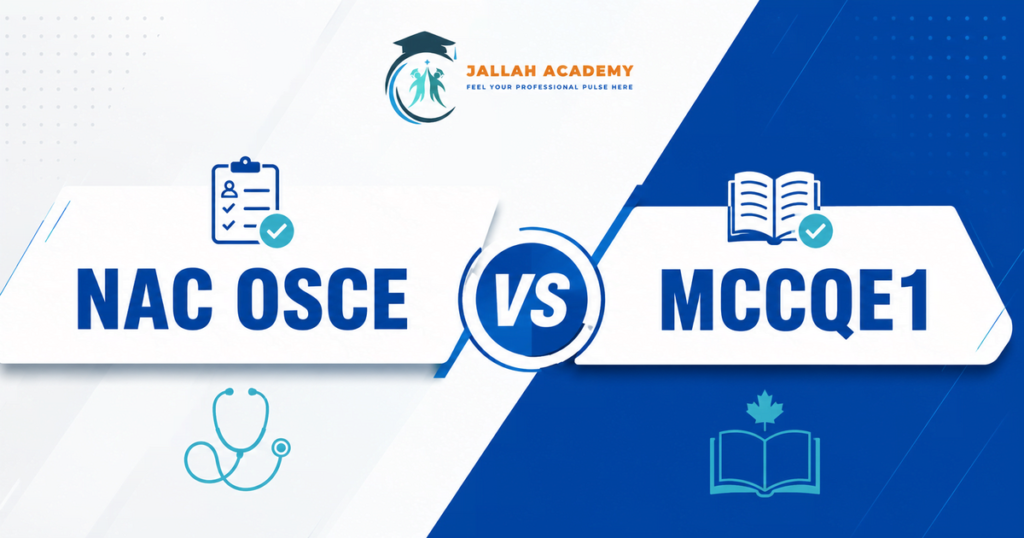
If you’re an IMG trying to get licensed in Canada, you’ve definitely heard these two names a lot. NAC OSCE. MCCQE1. Everyone talks about them. But not everyone explains them clearly, especially when it comes to which one to tackle first and how they actually differ. Let’s break it down in plain language. What Is the MCCQE1? The Medical Council of Canada Qualifying Examination Part 1, or MCCQE1, is a written, computer-based exam. It tests your medical knowledge across all core disciplines. Think internal medicine, surgery, pediatrics, psychiatry, ob-gyn, and more. It’s a knowledge exam. Multiple choice questions. Clinical decision-making cases. You sit at a computer, read scenarios, and pick answers. Key facts about MCCQE1: What Is the NAC OSCE? The National Assessment Collaboration Objective Structured Clinical Examination, NAC OSCE, is a hands-on clinical skills exam. You go from station to station, interact with standardized patients (real actors), and demonstrate real clinical skills. It’s not about picking the right answer. It’s about doing the right thing in real time. Key facts about NAC OSCE: Side-by-Side Comparison Feature MCCQE1 NAC OSCE Format Written / Computer-based In-person / OSCE stations Skills Tested Medical knowledge, reasoning Clinical skills, communication Duration ~4.5 hours ~3.5 hours Location Testing centers across Canada Select Canadian cities Frequency Multiple times a year Once a year Difficulty Focus Breadth of knowledge Applied clinical performance Study Style Reading, QBanks, practice cases Role-play, feedback, simulation The Big Question: Which One Should You Prep First? Short answer: MCCQE1 first, NAC OSCE second. Here’s why that usually makes sense. MCCQE1 Builds Your Foundation The MCCQE1 forces you to deeply review all your medical knowledge. When you study for it, you’re reinforcing clinical reasoning across every specialty. That same knowledge becomes your backbone when you face NAC OSCE stations. You already know the differential diagnoses. You already know the investigations and management steps. The NAC OSCE just asks you to deliver that knowledge out loud, in person. NAC OSCE Is More About Skill, Less About New Learning Most of what you need for the NAC OSCE, the medical content, you’ll have already covered while prepping for MCCQE1. What NAC OSCE prep focuses on is communication, structure, time management per station, and physical exam technique. That’s a specific layer you build on top of solid knowledge. Scheduling Reality NAC OSCE only runs once a year. MCCQE1 runs multiple times. So if you’re planning strategically, it’s safer to sit MCCQE1 first, pass it, then focus fully on NAC OSCE prep knowing your knowledge base is already certified. Can You Prepare for Both at the Same Time? Technically yes. And some people do it when their exam dates are close together. But it’s tough. The prep styles are very different. Written exam prep is desk work: reading, doing questions, reviewing notes. NAC OSCE prep is active: role-playing cases, getting feedback on your patient interaction, timing yourself at stations. If you try to do both simultaneously without a structured plan, you risk burning out or doing neither well. Having a coach or a structured program helps a lot here. What Makes NAC OSCE Harder for Most IMGs? Honestly? The communication part. The medical knowledge is there, you went to medical school. But delivering a full history, doing a focused physical exam, counseling a patient, and managing your time, all in 11 minutes, that’s a skill you need to practice repeatedly. Most IMGs underestimate this. They read about NAC OSCE, feel confident about the medical content, then walk in and freeze because they’ve never practiced with a real person under time pressure. This is exactly why simulation matters so much for NAC OSCE prep. How Jallah Academy Can Help Jallah Academy was built by Dr. Mohammad Nasir Jallah, an IMG who went through this exact journey himself. He passed the MCCQE (formerly MCCEE) and the NAC OSCE, got licensed in Canada, and then built a program to help other IMGs do the same. The academy offers dedicated preparation courses for both exams. For MCCQE1: The MCCQE1 Prep Course gives you access to over 6,000 practice cases, lecture notes, videos, and live evening classes Monday through Wednesday (8 to 11 PM EST). It’s structured to cover everything the exam tests, with clinical decision-making built in. For NAC OSCE: The NAC OSCE Prep Course covers all core subject areas, includes over 200 OSCE cases, and runs live classes Thursday through Saturday (8 to 11 PM EST). The focus is on building your station structure, communication style, and clinical confidence through practice and real feedback. And if you want to experience the real thing before exam day, Jallah Academy also runs NAC OSCE Simulation Exams and MCCQE1 Simulation Exams, giving you that high-pressure, exam-like environment where you can find your weak spots early. Final Thoughts Both exams are required. Both are passable. The key is knowing what each one is testing, prepping for them in the right order, and not underestimating the clinical performance side of NAC OSCE. MCCQE1 builds your knowledge. NAC OSCE is where you show your skills. Take them seriously, prep with the right support, and you’ll get through it. Hundreds of IMGs have done it before you, and they started exactly where you are right now.
How Long to Prepare for MCCQE1? A Realistic Study Timeline

How long to prepare for MCCQE1 if you want to pass with confidence? For most candidates, 2 – 4 months of focused MCCQE1 preparation is enough, while IMGs, working doctors, or candidates with a long study gap may need 4 – 6 months. If you study consistently for 15 – 25 hours per week, a realistic MCCQE1 preparation timeline is usually 3 – 6 months. International medical graduates may need 4 – 8 months, based on their clinical experience, medical knowledge, and familiarity with Canadian guidelines. Most successful candidates complete 1,500 – 3,000 practice questions and take multiple full-length practice exams before test day. This guide will help you choose the right MCCQE1 study timeline based on your background, available study hours, and exam readiness. Therefore, let’s get started! Quick Answer: How Long to Prepare for MCCQE1? Most candidates should prepare for MCCQE1 for 3 – 6 months. This timeline works well for students who can study consistently for about 15 – 25 hours per week. Candidates with strong clinical knowledge may be ready in 2 – 3 months, while IMGs, working doctors, or candidates with a long study gap may need 4 – 8 months. Candidate Type Suggested Preparation Time Recent medical graduate 2 – 3 months Full-time candidate 2 – 4 months Part-time candidate 4 – 6 months IMG with recent clinical experience 4 – 6 months IMG with a long study gap 6 – 8 months Working doctor 4 – 6 months The MCC recommends using the MCC Examination Objectives because they describe the knowledge and clinical abilities expected from medical graduates entering residency in Canada. The current MCCQE has 230 multiple-choice questions, divided into two sections of 115 questions, so students need regular MCQ practice, timed blocks, weak-area review, and full-length practice exams. For students who need structured lessons, regular support, and clear direction, Jallah Academy can be a practical option for using preparation time more effectively. What Is the Current MCCQE1 Exam Format? The current MCCQE1 is officially called the MCCQE, formerly MCCQE Part I. It is a one-day, computer-based exam that tests the medical knowledge, clinical judgment, and decision-making skills. The MCCQE has 230 multiple-choice questions. The exam is divided into two sections of 115 questions. Candidates get 2 hours and 40 minutes for each section. Questions may include clinical scenarios, images, diagrams, radiographs, ECGs, tables, or lab values. Each MCCQE question has one best answer. There is no penalty for incorrect answers, so candidates should answer every question. This exam format should shape your MCCQE1 preparation. A structured course can make this preparation easier to manage. Jallah Academy can help students follow an organized MCCQE1 study plan with guided lessons, practice support, and exam-focused review. Is 3 Months Enough for MCCQE1? Yes, 3 months can be enough for MCCQE1 if your basics are strong and your study time is consistent. A 12-week MCCQE1 study plan works best if you can study around 15 – 25 hours per week, complete regular practice questions, and review mistakes before test day. 3 months is not enough if you only read notes. The MCCQE tests clinical knowledge and decision-making through 230 multiple-choice questions, so your preparation should include MCQ practice, timed question blocks, and full-length practice exams. Choose a longer timeline if your basics are weak or your schedule is limited. IMGs, working doctors, and candidates with a long study gap may need 4 – 6 months or more to prepare properly. When Do You Need 4 – 6 Months? You need 4 – 6 months for MCCQE1 if you are an IMG, a working doctor, or a candidate with a long study gap. This timeline gives you enough space to review core subjects, understand Canadian-style clinical reasoning, and build exam confidence without rushing. MCCQE1 not only tests medical facts. It also tests how well you apply knowledge through clinical judgment, ethics, preventive care, and patient-centered decision-making. Working doctors and part-time students usually need a longer plan because their weekly study hours are limited. If you can study only after work or on weekends, a 4 – 6 month timeline is more realistic than trying to complete everything in 8 – 10 weeks. A structured course can make a 4 – 6 month plan easier to follow. Jallah Academy’s MCCQE Part I program is listed as a 6-month curriculum for IMGs, with live online and recorded sessions, 3 sessions per week, and 9 hours of instruction per week. How Jallah Academy Helps You Prepare More Effectively Jallah Academy offers a 6-month MCCQE Part I curriculum for International Medical Graduates, delivered through live online and recorded sessions. The program includes 3 sessions per week, 3 hours per session, and 9 hours of instruction per week. The MCCQE is a one-day computer-based exam with 230 multiple-choice questions, divided into two sections of 115 questions. Jallah Academy focuses on clinical decision-making, patient-centred care, ethics, professionalism, public health, preventive medicine, and exam-realistic scenarios. Structured Lessons Instead of Random Study Jallah Academy gives students a month-by-month MCCQE1 study path. The curriculum moves from internal medicine, ethics, and public health into cardiology, respirology, gastroenterology, endocrinology, rheumatology, orthopedics, surgery, emergency medicine, family medicine, OB/GYN, pediatrics, psychiatry, geriatrics, and final integration. This structure helps students know what to study, when to revise, and how each subject connects to exam-style clinical reasoning. Practice, Feedback, and Exam Confidence Jallah Academy uses simulation exams to help students measure readiness before test day. Its syllabus lists Simulation Exam 1 at the end of Month 2, Simulation Exam 2 at the end of Month 4, and a final full MCCQE1 simulation at the end of Month 6. Each simulation is designed to mirror the real exam structure, timing, and pressure, with immediate results, performance analytics, weak-area identification, and targeted remediation guidance. Simple MCCQE1 Study Plan by Timeline Choose your MCCQE1 study plan based on your current level, weekly study hours, and exam date. The MCCQE has 230 multiple-choice questions, so your preparation should include MCC Objectives, content review, daily
NAC OSCE Tips for IMGs: A Complete Preparation Roadmap

What if you know the answer during the NAC OSCE, but lose marks because your communication, timing, or station structure is weak? The NAC OSCE does not only test what you know; it tests how safely, clearly, and professionally you perform under pressure. For many International Medical Graduates (IMGs), success and strong preparation involve regular mock OSCE practice, effective communication, clinical reasoning, and a clear understanding of Canadian patient-centred care expectations. These NAC OSCE tips for IMGs can help you build confidence, improve performance across different station types, and avoid common mistakes. Candidates can improve their chances of success by participating in regular mock OSCE sessions over 8 to 12 weeks. In this article, you’ll learn practical strategies for preparing for the NAC OSCE, including how to approach patients, take focused histories, manage your time, and counsel patients. Therefore, let’s get started! What Is the NAC OSCE? The NAC OSCE is Canada’s clinical skills exam for International Medical Graduates. The Medical Council of Canada calls it the National Assessment Collaboration Examination, which assesses whether IMGs are ready to enter a Canadian residency program. Your NAC OSCE result directly affects your CaRMS eligibility. Many residency programs use it as a first-pass screening tool. A strong score expands your residency options. A weak score limits them. IMGs who want to apply to the CaRMS R-1 Main Residency Match need to provide results for the MCCQE and the NAC Examination. The exam tests clinical performance. IMGs must show that they can take focused histories, communicate with patients, perform or describe physical examinations, build reasonable diagnoses, and make safe management decisions in a Canadian clinical setting. Jallah Academy supports this exact preparation need. The academy offers IMG-focused Canadian licensure preparation through online and in-person classes, one-on-one mentoring, crash courses, physical examination training, and video lectures. NAC OSCE Format: Stations, Timing, and Standardized Participants The NAC OSCE is a half-day Objective Structured Clinical Examination. Candidates rotate through clinical stations that simulate common patient encounters in Canadian medical practice. The exam is usually administered twice a year, in spring and fall. The standard NAC OSCE has 12 stations. Two stations are pilot stations and do not count toward the final score. Each station lasts 11 minutes. You get 2 minutes between stations to read the door note and prepare. Each station starts with a written prompt. The prompt explains the clinical problem and tells the candidate what to do, such as taking a history, conducting or describing a physical examination, or managing a patient concern. Each station includes standardized assessment roles. The candidate interacts with at least one standardized participant, while a physician examiner observes and scores the encounter. Station types include, What the Exam Actually Tests The NAC OSCE tests clinical performance. Examiners score you across six core areas. 1. Clinical Reasoning: Generate a focused differential early. Ask hypothesis-driven questions. Show logical thinking through your line of inquiry. 2. Communication Skills: Speak clearly, listen actively, and respond to the patient. Canadian clinical culture prioritizes patient-centered communication. Formal or detached language will cost you marks. 3. History Taking: Take a structured, efficient history within the time limit. Cover presenting complaint, associated symptoms, past medical history, medications, allergies, family history, and social context. 4. Physical Examination: Perform the correct exam for the clinical scenario. Examiners look for proper sequencing, hand hygiene, patient draping, and accurate technique. 5. Patient Safety and Professional Behavior: Introduce yourself. Obtain consent. Respond appropriately to distress. Every station assesses if your conduct is safe and professional. 6. Management Reasoning: Close each encounter with a coherent plan. State your top diagnosis or working impression. NAC OSCE Tips for IMGs: Practical Strategies to Improve Your Performance The following NAC OSCE tips for IMGs can help you prepare more strategically and perform with greater confidence on exam day. Tip 1: Understand Canadian Clinical Expectations Canadian clinical expectations define strong NAC OSCE performance. A general foreign OSCE approach may not match what the NAC OSCE expects. Treat this as a different test entirely. The medical facts matter. How you apply them, with whom, and in what tone matters more. Canada Expects a Specific Type of Doctor Patient-centred care is the core standard of Canadian clinical practice. The Medical Council of Canada describes the communicator role as patient-centred therapeutic communication. Shared decision-making is expected in every management discussion. Explain options clearly, check the patient’s understanding, invite questions, and include the patient’s values. Communication Style Open every encounter with a warm, professional introduction. State your name and role. Confirm the patient’s name. Use plain language. Replace “elevated myocardial infarction risk” with “your heart is under serious strain.” Speak to the patient, not at them. Empathy must match the patient’s concern. Say something specific when the patient shows fear, pain, frustration, or confusion. For example: “That sounds very worrying, especially because the pain started suddenly.” Safety and Consent Consent protects professionalism and patient safety. Ask permission before asking sensitive questions, performing physical examination steps, or discussing counselling topics. Use consent naturally, especially during sexual history, psychiatric history, family violence, substance use, or physical examination stations. Maintain correct exam conduct throughout. Proper draping, patient positioning, and physical boundaries are observed and scored. Professionalism Professional behaviour matters throughout the station. Maintain respectful language, avoid jargon, listen without interrupting, protect dignity, and stay calm under pressure. Close every encounter with a clear, respectful summary. Recap the key points. Check the patient’s understanding. Ask if they have questions. Jallah Academy teaches Canadian-style NAC OSCE performance. Its NAC OSCE curriculum prepares IMGs to perform at a Canadian PGY-1 level through patient safety, communication, professionalism, structured clinical reasoning, and OSCE-specific performance skills. Tip 2: Use a Clear Station Structure Every Time Use the same station flow every time. Read the prompt, identify the task, greet the patient, confirm identity, ask consent, complete the focused task, summarize findings, explain the plan, safety-net, and close professionally. Tip 3: Manage the 11-Minute Station Like a Skill Each NAC OSCE station lasts 11 minutes, with 2 minutes between stations
IMG Medical Licensing Canada: Requirements, Exams & Pathways
IMG medical licensing Canada is the process that International Medical Graduates follow to become doctors in Canada. International Medical Graduates (IMGs) can obtain medical licensure in Canada by passing the required Medical Council of Canada examinations, meeting provincial licensing requirements, and completing residency training when required. Licensing pathways vary by province. Most IMGs must demonstrate language proficiency, verify credentials, and obtain certification before independent medical practice. This guide provides a complete overview of the IMG medical licensing in Canada, including MCCQE preparation, NAC OSCE requirements, CaRMS applications, practice-ready assessment options, timeline expectations, and exam preparation tips. Therefore, let’s get into it! What Is IMG Medical Licensing Canada? IMG medical licensing Canada means the process that International Medical Graduates follow to become eligible to practise medicine in Canada. An International Medical Graduate, or IMG, is someone who completed medical school outside Canada and wants to enter the Canadian medical system. Most IMGs need to verify their medical credentials, apply through official systems, pass the required Medical Council of Canada exams, and meet the rules of the province or territory where they want to work. Through Medical Council of Canada services, IMGs can submit credentials for source verification, apply for exams, and share results with Canadian medical regulatory authorities. Two major exams in this pathway are the MCCQE and the NAC Examination, also called the NAC OSCE. The MCCQE assesses medical knowledge, clinical decision-making, and passing it is required for IMGs applying to Canadian residency programs. The NAC OSCE tests the clinical skills, communication, and professional behaviours needed for entry into residency in Canada. Many IMGs apply through CaRMS, match into a Canadian residency program, complete postgraduate training, and then move toward provincial registration. In simple terms, IMG Medical Licensing Canada is a step-by-step process. It usually includes credential verification, MCC exams, possible NAC OSCE requirements, residency or PRA planning, and provincial medical registration. Who Is Considered an International Medical Graduate in Canada? An International Medical Graduate in Canada is a doctor or medical graduate who completed medical school outside Canada. IMGs are also known as foreign-trained doctors or internationally trained physicians. You are usually considered an IMG if: For Canadian recognition, the medical school usually must be listed in the World Directory of Medical Schools and have a Canada Sponsor Note. Why IMGs Have Different Requirements IMGs have different requirements because their medical education was completed outside the Canadian accreditation system. Canada must verify that their training, documents, and exam results meet local standards. Common requirements for IMGs may include: CaRMS states that IMG applicants for the R-1 residency match generally need to pass the NAC Examination and the MCCQE Part I. Step-by-Step: How IMGs Can Practise Medicine in Canada The exact steps can vary by province, so IMGs should always confirm requirements with the medical regulatory authority where they plan to work. Step 1: Create a physiciansapply.ca Account IMGs should first create a physiciansapply.ca account. This is the main online portal used to access Medical Council of Canada services. Through physiciansapply.ca, candidates can apply for MCC exams, submit documents for source verification, view exam results, and share verified credentials with approved organizations. Step 2: Verify Medical Credentials IMGs must verify their medical credentials before moving forward in the licensing process. This confirms that their medical degree and other documents are authentic. Step 3: Check Provincial Licensing Requirements IMGs should check province-specific rules early. Canada has national exams, but each province and territory has its own medical regulatory authority. This means the requirements for Ontario, Alberta, British Columbia, Manitoba, or another province may not be the same. Step 4: Prepare for MCCQE Part I IMGs usually need to prepare for the MCCQE Part I. This exam tests medical knowledge and clinical decision-making in a Canadian context. Preparation should focus on clinical reasoning, ethics, public health, patient safety, and timed question practice. For IMGs who need a clear study structure, Jallah Academy offers MCCQE1 preparation with live online and recorded sessions, case-based teaching, notes, lecture videos, and simulation-style practice. Its MCCQE1 program is described as a 6-month course with 3 classes per week and 9 hours of weekly instruction. Step 5: Prepare for NAC OSCE Many IMGs also need the NAC OSCE, especially if they plan to apply for Canadian residency through CaRMS. The NAC OSCE tests clinical skills such as history taking, communication, physical examination, diagnosis, management, and professionalism. Jallah Academy’s NAC OSCE preparation covers OSCE foundations, history taking, communication skills, physical examination, ethics, professionalism, challenging stations, and Canadian clinical culture. Step 6: Apply Through CaRMS or Explore PRA Most IMGs apply for residency through CaRMS, the Canadian Resident Matching Service. This is the main residency matching system in Canada. Some experienced doctors may explore Practice-Ready Assessment, also called PRA. PRA is usually for physicians who already have independent clinical experience and meet province-specific requirements. Step 7: Apply for Provincial Medical Registration The final licensing decision comes from the province or territory. After exams, residency, PRA, or other required steps, IMGs must apply to the medical regulatory authority where they want to practise. MCCQE for IMGs: Format, Purpose, and Preparation The MCCQE is one of the main exams International Medical Graduates need for medical licensing or residency in Canada. It tests if candidates can apply medical knowledge, make safe clinical decisions, and work at the level expected of a medical graduate entering supervised practice. Quick MCCQE Overview MCCQE Detail What IMGs Should Know Full name Medical Council of Canada Qualifying Examination Main purpose Tests medical knowledge and clinical decision-making Question type Multiple-choice questions Total questions 230 MCQs Exam sections 2 sections Questions per section 115 MCQs MCCQE Format and Question Style The MCCQE is a one-day computer-based exam with 230 multiple-choice questions. The exam is divided into two sections, with 115 questions in each section. Each section includes pilot questions, but candidates will not know which questions are pilot questions during the exam. The questions are usually based on clinical situations. Candidates may need to choose the most likely diagnosis,
